

Then, in my inbox appeared the following miraculous, beautiful, shocking, most unlikely combination of words:
Your entry “Graemist” has been selected as one of three Winners of the Letter Review Prize for Unpublished Books.
I remember going numb.
Would you please tell us a little about your writing process?
I hesitate to explain my writing process. It might be taken as advice from an expert or role model, which couldn’t be further from the truth. One reads these things and nods sagely, “This is how it should be done.” No. Everyone is different. How could my writing process possibly help Nigella down the road with her story about a cat with magical powers that invades Russia and gives everyone cat flu? Can’t be done. It’s nonsense.
Not your story, Nigella! It’s actually growing on me: politics, adventure… and a cat. What more could you ask?
The thing is, I was very kindly awarded The Letter Review Prize for an unpublished novel, and I am exceptionally proud and grateful for that recognition. But that’s it. That’s the one thing that says I am a writer. That, and a couple of plays being produced… okay, a couple of things. So, imposter. I’m a fraud. How can I possibly expose my process when it is so doubtful?
I will concede, grudgingly, that doubt may feed said process – and I am jumping ahead here – by driving me to perfect my various drafts, my many drafts, my long, exhaustive, rocky mountain road of drafts; by making me question whether sir Simon would say ‘discombobulated’ when he has been monosyllabic previously or if Xthrmyn, the protagonist, would truly eat gherkins before a battle (what about heartburn?), and do lilies really bob in the wind like exultant headless ballerinas? Should there be a comma there? Are dashes okay? Ellipses? How do I get from here to here? How? Bernard Cornwell would know. Isabel Allende, Paulo Coehlo. Me? Not so much. But that doubt makes me strive. Or completely seizes me up. That’s the other side. We will ignore that. Therefore, in the spirit of the maxim, ‘We learn more from our mistakes than our successes’, I continue.
So, process. Mine… I’m with Agatha Christie’s creation, Ariadne Oliver: “First, you’ve got to think of something, and when you’ve thought of it, you’ve got to force yourself to sit down and write it. That’s all. It would have taken me just three minutes to explain that.” I can’t cite which novel, sorry. I think there was a lake.
Ideas just come. You need room for them, but then they just happen. ‘My best ideas come in the shower…’ maybe they do, maybe they come while sitting in mud or reading someone else’s legitimate writing or watching a leaf fall on your pyjama bottoms. If you have them. And why are you wearing them outside? The best come when you haven’t paper or pencil or both. Neither. When the cat’s just settled on your lap or at 3 o’clock in the morning.
But, they aren’t complete, are they? Ideas. They have to grow. Swell. Fill out. The idea was tall but had yet to fill out. Time is the thing. They take time, usually. You can push it. Think things out. Why is she dancing with mushrooms? Is she a cook? A witch? A pagan fire goddess cooking… mushrooms? Are they really toadstools? Cliched? Truffles! To summon her flying pig. And then she bumps into Nigella, and that is how she discovers the cat is invading Russia! Of course! Which is why the Russians keep bombing children’s playgrounds: to get the cat. Why else?
Now, lots of questions. Do you plan or just write as it comes? Yes. That’s all I’m going to say. That and it depends. Done both. Done a mix. Made an omelette.
Will you stop for the day while ‘in the flow’, to easily pick up again the next day? When I was young that often worked. Days could pass, a week. I would come back and reread (and rewrite), and off I’d go! Now… if I sip my coffee: tumbleweeds. Gone. I chase my tail like a demented dog: “And she realises she is a reincarnation of Peter O’Toole … How? I had it! It was sublime!” Notes don’t help. Short of writing out the complete text, the connection is gone. No matter my new solution, what is lost was perfect. Suggestions gratefully received.
Do you rewrite? Are you insane? Look at this abomination! This is what happens if I don’t. It is a lesson. Do I rewrite? Graemist was written when I was at university. I am now… not at university. By lots. We’re not talking Rip van Winkle but… a significant passage of time has passaged. Passed. Past? Passed. With every crisis precipitated by lack of achievement a rewrite has occurred, and they are still occurrencing: Oh, that poor first sentence!
I read things out to myself. The cat thinks I am insane. It helps at feeding time. I feel the rhythm, hear the sounds. I play Tetris with words, have inspirations; see redundancies, holes; query direction; look for quirks… And the next day, look again before moving on. Coming back months, years later for the next rewrite (crisis), I am either amazed, “I wrote this!” or dismayed, “Writer, schmiter; I should be a taxidermist, trying to make dead things look alive like this.”
And then I rewrite.
Why? Why did I start? What was I thinking? Well, I wasn’t thinking. I was feeling. I was overwhelmed with that driving… nagging… energising… enervating… sublime… rollercoaster… swamp… thing. That desire. That compulsion. That poison and drug. I have to tell stories.
Do you enjoy writing?
Yes. Mostly. No. Can we move on, please?
I enjoy the arrival of an idea, the energy of it, the chasing of threads as they weave into a writeable something. I enjoy puzzling out the first sentence. Mostly. And the next, and the next… I adore that feeling of being in the flow, in that Zen place where words just pour out and, if you stumble, that’s part of the fun. Characters suddenly taking off on their own, without your help, is the most sublime feeling. Finding that Nabokovian Bell of my own – well, aspiring to approach such clarity of description – is most satisfying, and the challenge of it: inspiring. I love the embrace of a story, its warm immersive cocooning from real life.
The dark days are not enjoyable:
- This has to happen next, but how do I get there?
- I wrote this contrived, clichéd, banal, incomprehensible drivel? What does it mean?
- Wait, she can’t be fifteen if she was born under the third sphere of Chritchturpin, so she isn’t a minor and, therefore, should be wearing the scarf of adulthood and, thus, would never be allowed an audience with the Demon Thursday in the temple. It all falls apart!
- I had the perfect word when I started this sentence, what was it?
- “So saying, his hand slipped from mine, and his soul sighed one last time into Infinity…”
- I can’t do it. No one will read it. What’s the point? It’ll only end up clogging up the computer, deleted when I am deleted, seen by nobody.
But then, there is a breakthrough. She can meet the Demon Thursday out of the temple! That way she will realise that he’s really the tailor from Bodger Street with a wig and sparkly costume, which will allow her to take the Diamond of Golden Hydrangeas without fear of a curse, and free the Toad of Remonstrance. Perfect! Two for one! Relief! Maybe, elation!
And, the best and worst feeling? Finished.
What is the role of the writer in society? What do you believe is the function of your art?
Considering my apparent flippancy elsewhere, these may be odd questions – and much too deep – for me to attempt to answer. My response? I will answer them anyway, and together.
The writers’ role is to write. This may seem like an oversimplification but the term ‘write’ encompasses a vast array of styles, genres, forms, intentions, purposes and social significances, which all make this umbrella term complicated. This statement will refer to the writing of fiction to limit the scope. It will also apply to the writer intending to be read, to distinguish from those self-possessed individuals for whom the process of writing itself is the sole satisfaction and goal.
The fiction writer, it could be argued, has three roles to fulfil. They are to entertain, to connect and to heal. The writer being the originator of the art form, their role will correspond with its functions: to entertain, to connect and to heal.
The first, to entertain, is obvious. The writer employs story, character and setting, they create tension and its release, they evoke the familiar and recognisable in order to ground the startling and unexpected, they provoke thoughts and emotions, all to divert their audience. The reader (and, frequently, the listener in these days of audio books) is invited to open themselves up to another existence, whether through humour, drama, suspense, adventure or a myriad of other forms and combinations of forms, and to enjoy the experience. If the act of reading was a story in itself, it would be a romance in the old sense: the journey of someone taken out of their normal life. In this case, the reader’s journey is chosen, not thrust upon them by fate. It is a solution rather than a problem. The warmth of the open page is an offer to escape and to achieve a catharsis.
Connection is a basic human need and, as a human art form, writing provides an opportunity to connect. The writer wishes to share with appropriate readers; the reader wishes to be included, to experience and to feel. Both want to know they are not alone. It is emotional. It is natural. It is intrinsic. By immersing oneself in another’s words, a reader can befriend a character, travel with them, feel for them, understand them, hear another’s thoughts in a way that they cannot in real life. And they are not judged. They may judge, but they are not judged back. It is a welcoming proposition.
Healing is, arguably, the aim of the other two functions. By engaging in the act of being entertained – of escaping – by reaching out to connect with another – by sharing – both writer and, especially, reader may gain understanding and relief from the slings and arrows of outrageous fortune that is their normal life. In a theatre or cinema the audience is invited to feel emotions en masse, in a safe space – usually darkened so no one sees (unanimity). This allows a shared release of tension and a lifting of spirits that would otherwise be left bottled up, facilitated by the performance. By writing and reading alone in their respective garrets, writer and reader experience the same release and lift in another, safe environment. Through escapism, through immersion in a story, through connection to a character or a situation, a break is created from current stresses, and often an expression and resolution, or venting, of unconscious pent up emotions can be achieved. This is healing: a pause in symptoms, an easing of tensions, the chance to feel and release. This occurs through writing.
Healing also includes a responsibility. In Osho Zen it is understood that something is not art if it spreads the artist’s sickness. It is like the Hippocratic Oath: First, do no harm. The writer has a duty of care. We all have biases, conscious and unconscious. We see a difference, we make a judgement – like or dislike – and we act accordingly. The reader does the same thing. They make choices, conscious and unconscious, whether to enjoy, to consider, be offended or feel justified. We are often shocked to discover we have these biases, especially when we directly see and experience how it hurts another human being. What is the writer passing on to the reader? What is the message? What is being extolled or vilified?
This is not a call for censorship. There is no black or white, no absolute, no firm and fixed line delineating what is acceptable and what is not. It is a consideration. It is a questioning of intent. It is a gentle call to be human and to take care of one another. It is an act of humanity, just as telling a story is an act of humanity. Harm may be portrayed. After all, conflict is the inflicting or the threat of harm and is necessary to create tension (interest) in a story, but there needs to be redress in some form, whether that be hope, repair, understanding, learning, warning, guidance, punishment or victory. This redress is how catharsis is achieved, by releasing the reader and giving resolution. The final aim of healing is to lift up, to accept, to free.
Also, this is not a call for more stories about fluffy kittens befriending ducks and having jolly picnics in the sun. The ending does not have to be happy. It can be disturbing. The true question is: what is the reader left with and encouraged to be? If there is hope or discovery or a universal truth gained from the entirety of a work, if there is a redress, then there is healing, you have done no harm.
Each of the three functions/roles are overlapping, feeding each other to make a whole. This is a brief overview containing very little deep thought, and should be treated as such. As with everything, it is easy to be mired down in absolutes. These are more thought points than rules.
Which successes are you most proud of?
I have a play. It is called “Courting Temptation” – I have never been happy with that title but it has stuck. Titles are hard! But I digress.
This was the first of my plays to be performed. Despite many setbacks and ill omens, it was a great success. I was very pleased with the response of, first, the actors and, then, the audiences to the words and story. But the greatest point of pride comes from the comments that continued to come months after it had closed. I was stopped in the street a couple of times, by people who recognised me and wanted to talk about the play. Actors had reports from audience members who were still thinking about it and its themes. In a positive light, need I add? They got it. They had seen through the façade of comedy to the musings beneath. That feeling of being understood is very humbling and comforting. It is the most wonderful reward.
Similarly with the great honour gifted me by The Letter Review in awarding Graemist the unpublished novel prize. This came at a vital moment for me. I was in the depths of doubt. I had just finished the rewrite of another novel, I thought. I had started scanning the early sections for plot points to construct a synopsis and found errors. Horrible errors. Jagged edges, missing words, muddy descriptions, repetitions. My faith in what was written had vanished, after months of work. I was also in the process of, finally, attempting to get a literary agent. The response? Tumbleweeds. Nothing. Silencio. So, confidence low, success nil, and proof of worth entirely dependent on self-confidence so, rock bottom. Under the rocks on the bottom. Beneath the silt beneath the rocks on the bottom. Oh, and confusion: beyond stratospheric, it was outside the solar system. What do these agents want? I’m lucky I still have hair and I haven’t been locked away.
Then, in my inbox appeared the following miraculous, beautiful, shocking, most unlikely combination of words:
Your entry “Graemist” has been selected as one of three Winners of the Letter Review Prize for Unpublished Books.
I remember going numb. I read it several times. I had seen it in my inbox and thought, “Oh no. Another failure.” So, I was unprepared for what it actually said. I was very quiet for some time. I think I whispered when I asked my wife to read the email. I glowed for weeks. I was a writer.
The timing was amazing. I still get the most glorious of feelings recalling that moment. And, again, it came from the realisation that someone else got it. They understood. Maybe, just maybe, I have some talent. It is a wonderful feeling!
Would you mind sharing a photograph of a part of your bookshelf (or your library) that is meaningful to you? What makes it meaningful to you?
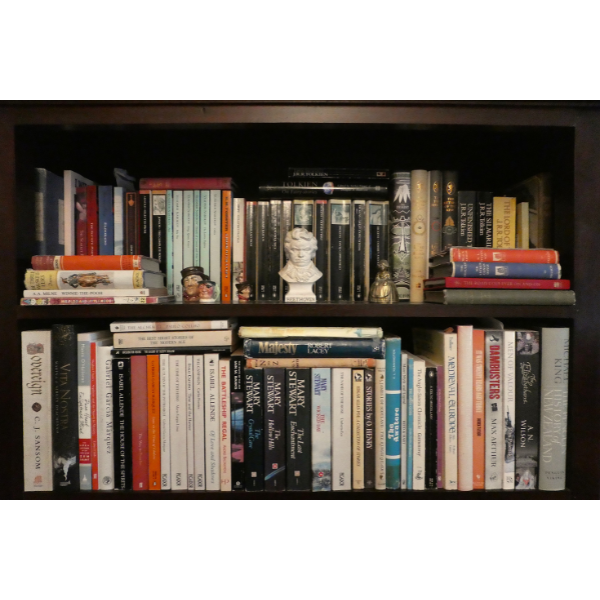
This is a small section of one of my bookcases. It is a lovely wood. It is pleasant, and smooth, and deep to the touch. It holds books, which makes it even more special. One was written by a good friend who encouraged me long ago, and shared his work. Another is written by my sister-in-law, whose originality and brilliance inspire. Others were given to me by a beautiful woman, whose intelligence and patience broadens my world: through her own writing and support, and by just being. Some of these books are from my days at university, and before, when everything was possible. Some I have found in sales and clearances in shops and libraries; trophies from a search or adventure. Some I simply had to have but are still unread. Some are cherished and will be reread and reread. Some completely invaded my soul, while others struggled to engage me until a magic phrase or description reached out and tapped me on the brain. They are comforting. They are satisfying. They are warm and tactile. They inspire. All of them, I cherish.
David Allen is a writer, actor and playwright based in Christchurch, New Zealand. He has a Diploma in Performance Art from the National Academy of Singing and Dramatic Arts, and a Bachelor of Arts (Honours) in English Literature from the University of Canterbury (New Zealand). Several of his plays have been produced and range from gothic mystery to period comedy and romance. A fan of Marina and Sergey Dyachenko, Ursula Le Guin, J. R. R. Tolkien and Tad Williams, he writes mostly speculative fiction. The real world is far too unbelievable! He experiments with the Gothic, sometimes downplaying the overt fantasy elements of his world to create an alternate history, magical realism construct. To date, he has written a full-length novel (Graemist), a novella, and is in the process of editing his second novel.