

I write to make sense of the world. The inverse also applies – hopefully my writing gives insights into a way of thinking and perceiving that is not mainstream.
Would you please tell us a little about your writing process?
Romancing Harpa involved a lot of research. I began by reading the Icelandic settlement sagas because one character is from that era – 10th century. The building – Harpa Concert Hall – features throughout the story so I explored that history, including a banking crisis of which Harpa became symbolic.
This is the 6th draft of the novel. I struggled to establish the clock of the story. The storyline was clear from the out, but where to start, how much backstory. When I realised that I was actually writing a romance, albeit an unusual one, the clock, voices and inciting hooks came together.
Which successes are you most proud of?
Winning Arts Council England and British Council funding to make two ten-day research trips to Iceland set the scene for incredible, life-changing experiences in a country I had not previously visited. It felt like permission to write this story. Sometimes an outsider with specialist knowledge can cast a different light that shows intriguing nuances. This has always been my intention with this story. Harpa is essentially a skyscraper and that’s something I know more about than most.
What motivated you to write Romancing Harpa?
It began as a random flash fiction piece that didn’t win. Yet there was strong positive encouragement to develop that story further early on. After the trips to Iceland, it was clear that the readers I most hope to reach are Icelandic. I have focussed on writing this story in a way they will appreciate and it is my hope that someday it will merit translation into Icelandic. Personally, it feels like Romancing Harpa justifies those many years of detailing skyscrapers that I often did not enjoy.
What have been your most meaningful or profound experiences as a writer?
I used to be commissioned to interview Olympic athletes, then write feature articles about them for a magazine. This taught me to prepare for each meeting by researching existing articles and the athlete’s career history. I also learned to think between the lines. I never wanted to write again what had already been told. I always sought ways to entice the athletes to share insights they hadn’t been asked about before, always with the greatest respect for each person.
During the year it took to win funding to visit Iceland, I wrote into this Harpa story, guessing and imagining plot points. When I had the opportunity in Iceland to meet with the Director of Harpa, members of the famous ICE-SAR search-and-rescue team, a fisherman, an expert mountaineering guide and sheep farmers in the far north, it was overwhelming to learn what I’d got right and where I’d gone wrong. Without that work I’d done in the year leading up to those two trips, my time spent in Iceland would have been much less enlightening. As frustrating as it was at the time, I’m grateful for the travel funding delay.
Would you mind sharing a photograph of a part of your bookshelf that is meaningful to you?
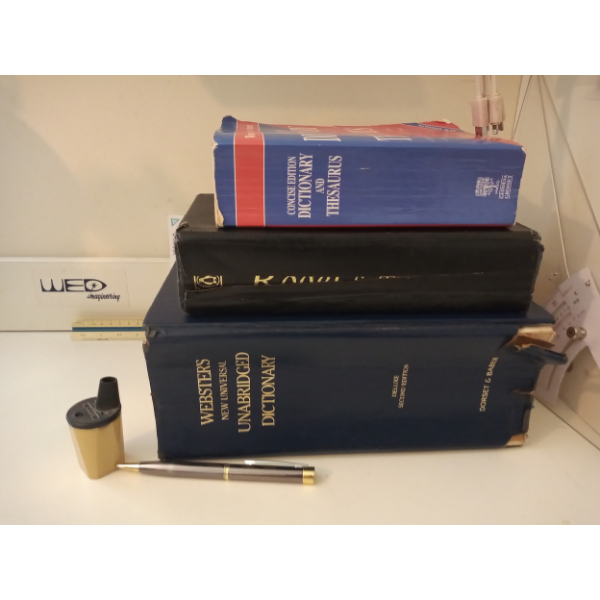
Here’s a view from my writing/drawing desk. These three books figure in most of what I write. One is an unabridged American English dictionary from 1975. It cost $5 and I’ve carried the bloody thing around the world with each move, always thinking it should be left behind or discarded. I am so glad I’ve kept it! It often provides fascinating insights into the history of words and is a direct connection to my personal past. I bought it new.
The shabby-looking thesaurus has limits but it is truly helpful.
One of my sons spent £1 on the combined dictionary and thesaurus. It is, of course, much simplified and abbreviated but sometimes hits the spot like nothing else. I also love the respect shown when a very young child makes a gift such as this one to his mother. You are a writer never feels trite.
What do you believe is the function of your art?
I’m a neurodivergent person as is one of the main characters in Romancing Harpa, so Johannes shows an extreme version of the tints I feel. I write to make sense of the world. The inverse also applies – hopefully my writing gives insights into a way of thinking and perceiving that is not mainstream.
In addition to offbeat thought processing, I also benefit from a visual anomaly. Pareidolia is perception of faces and creatures in unusual places.
Romancing Harpa is a romance novel focussed on Harpa Concert Hall in Iceland. Harpa benefits from skyscraper technology exterior curtain walls. For fifteen years, Donna McLuskie drew scaleable working drawings for high-rise building construction in New York City and London. Her interest in detail and love of drawing are manifest in research chemist JÓHANNES’ eventual love for HARPA. It is his intense empathy for this building that leads ÁSTRÍÐUR RÓS’ to fall in love with Jóhannes, creating a unique love triangle between Ásta, Jóhannes and the concert hall. Donna’s work as architectural technician began at DisneyWorld and ended in London. As a pareidolist – who perceives faces and creatures hidden in inanimate objects and unusual places – Donna has developed her love of drawing into the award-winning fine art business Hidden Creatures Art. Arts Council England and the British Council jointly funded two research trips to Iceland for Donna to familiarise herself with Harpa, the Icelandic nation and Icelanders as this novel-in-draft has progressed. Donna’s short fiction and poetry has been published in Canada by The Soap Box Press. Romancing Harpa has been longlisted for the Bridport Novel Prize and a short story based on this novel-in-progress was published for First Story’s Teacher Award. Originally from the US, Donna now lives in a village near Cambridge, England.