
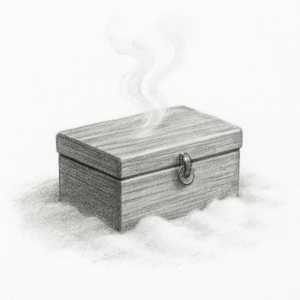
It was hard to believe that this box, the size of a small dog, contained a person. Most people had no idea that it did. Only Clay could hear the voice. If James and Lisa had shown up, they’d have heard it too.
Winner of The Letter Review Prize for Short Fiction
Return Policy
He could fool himself, but he couldn’t fool the empty road. They were late, more than an hour already, and no cars were coming from the left or right. The snow kept falling, thickening the white blanket that covered the flat, empty land.
His clients had backed out.
He’d parked by the roadside, next to the billboard with the toothpaste ad. In bright green letters, it promised a lifetime without cavities. James and Lisa, his clients, had chosen this spot for the exchange. Far outside town, isolated. Perfect for their deal.
“So nobody can…you know…disturb us,” James had said.
Clay could’ve told him that their deal would look perfectly normal to everyone else. But he stayed quiet. What did it matter to him? The spot was as good as any.
Now, sitting around in the white nothingness, he regretted his silence. Out here, he couldn’t order a drink while he waited. He couldn’t even look at anything except for snow and naked trees.
He checked his phone again. No messages.
“Unbelievable,” Clay mumbled.
He glanced at the wooden box on the passenger seat.
His clients were brother and sister. Thirty-somethings with round faces and a shared habit to bounce their legs while they listened. They had held hands during their first meeting. The meeting where Clay explained what they were getting themselves into.
He met them at a diner at seven p.m. sharp – they’d been punctual then – and outlined what he’d do, when they could expect results and when they’d meet for the exchange. He told them that they’d have one month with the person they chose.
“We take the deal,” James said, trying to make his voice sound lower. Lisa squeezed his hand and nodded.
Clay’s nose started running and he scrambled for a tissue. As far as he could see, the road was still empty. They weren’t coming.
He’d been stood up by clients before. Left in motel rooms with curtains blackened by mold, near abandoned farm houses in the middle of nowhere. That was part of the job. In his business, people didn’t write emails to cancel. They got scared and disappeared, hoping he would too.
Which he usually did. He received half his fee upfront and wasn’t violent enough to hunt the rest, not the guy to start breaking bones until he got his pay. So he let his clients go quietly.
It wasn’t like the police could help.
Still, he’d driven two hours and waited another one. For nothing. He breathed against his fingers, kicked the car’s floor. He smashed his fist against the dashboard.
Was it so hard to send a text?
He punched the glove compartment again.
“That’s not going to help,” the box on the passenger seat said.
Clay sighed, rubbing his hands together.
“I’m sure they got cold feet,” the box added with the rusty voice of a woman who’d started smoking early and never managed to quit. “Typical.”
It was hard to believe that this box, the size of a small dog, contained a person. Most people had no idea that it did. Only Clay could hear the voice. If James and Lisa had shown up, they’d have heard it too.
He stepped out of the car. The cold air bit his face and snow gathered on his uncovered head. His eyes teared up while he looked left and right. No car was coming. A few crows, resting on naked tree branches, were his only living company.
He got back into the car.
“I’m telling you, they won’t come,” the box said. “The two have always been unreliable.”
He looked at his phone. Nothing. Two adults and both had decided to disappear without a word.
“Are we going back?” the box asked. Her voice was so clear, so…normal. How easy it was to believe that he sat next to a living, breathing person.
Clay shifted the car into first gear and turned around on the snow covered road. A two hour drive was ahead of him.
He drove slowly, thinking of his apartment, while the wind rattled the car. Back home he’d take a hot shower and then crawl under the covers. He’d order pizza when he woke up. Take the rest of the week slow.
“It’s frustrating, right?” the box said. “You can’t imagine how often they broke their promises to me. They’re probably in a bar, telling each other how they did nothing wrong. That’s what they’re good at. Taking responsibility off their shoulders. Making it disappear into thin air. As if they could ever do something wrong.”
She huffed, although she had no lungs and no mouth to huff with.
“I’m glad they didn’t show up. They would’ve just tormented me. Tell me again and again how everything’s my fault. That I was too harsh, too lenient, whatever. There’s no winning with these kids.”
Lisa had chewed on her nails while she spoke about their mother, and James had scratched his neck as if he’d lost something under the skin. They gave him the first half in cash, in a blue sports bag, and when Clay got up from their table, Lisa started to cry.
James had put an arm around his sister, whispering soothing words in her ear.
“Can’t they leave me in peace?” the box said. “How self-centered can they be? Harassing their own mother even after she died. Didn’t they abuse me enough when I was alive?”
She hadn’t been happy to go back, but like most spirits, she only realized what happened when she was already back in the world of the living. For five minutes, she cursed him out. Then she started negotiating. Finally, she accepted her fate.
He’d release her once he got home. The spirits returned to the afterlife after one month if he didn’t intervene. It was a bad idea to keep them longer, stuck to an object, with no freedom, no agency. It wasn’t like they could do much to kill time. They could talk, but only to him and people who paid for the privilege.
That would make anyone lose their mind.
There had been problems with spirits who stayed longer. Doors that suddenly locked, knives that went missing, pets that never stopped growling. As far as he knew, the spirits couldn’t interact with the material world, but there had been too many coincidences. Hence the one-month-rule.
No more jobs for the next month, Clay promised himself. Even half his fee could cover his bills for a while.
“Ungrateful brats! Both of them!”
There was still only snow around him. No cars, no houses on the roadside. As if he was the last person on earth.
“How long have you been in this business?” the box asked.
He’d stop at the first cafe he saw and spend an hour inside. Drink too much coffee. Look at the menu, the walls, the ceiling. Anything that wasn’t white.
“How long?”
He gripped the steering wheel harder.
“I know you can hear me and I won’t shut up until you answer. It’s the least you can do after abducting me.”
She’d been seventy-one when she died. Lung cancer. Even as a spirit she kept the rusty voice of a longtime smoker.
Clay sighed and relaxed his fingers.
“Fifteen years,” he said.
The woman had no face, but somehow, he imagined a smile floating above the passenger seat.
“And what brought you into this strange profession?”
Her tone shifted. She sounded amused. As if he talked to a teenage girl who just enjoyed teasing him, not a dead mother of two.
“Let’s say people in my family have a talent,” Clay said. “It’s something we’re born with.”
As a teenager, he’d talked to whoever he could find, his great-grandparents, the neighbor’s dead husband, children who were kidnapped close to his house fifty years ago. He talked to historical figures, which was more difficult than expected. He couldn’t locate them easily and even if he did, there were communication problems. Like the time he got a hold of Genghis Khan, only to be screamed at in what he assumed was Mongolian.
“I can’t believe how nonchalant you are,” the box said. “Your…job is to resurrect the dead. You know what I did? I was a cashier. Part-time. And full-time mother and housewife. Then I retired and died. The most exciting thing I did was a trip to New York City. And you have this gift and talk about it like it’s normal. If I had your abilities, I’d value them much higher. I’d use them to do good.”
Somehow, even as a wooden box, she managed to sound self-righteous. He pictured her wagging a finger at him like a disappointed schoolteacher.
“At least I’d bring back my loved ones,” she continued. “Not forever – just to say things I never did. Or I’d explore the past, talking to…”
He ignored her. She wouldn’t come up with anything he hadn’t tried. Talk to murder victims and expose their killer? Sure, but how to convince the police? He tried giving them subtle hints once, leading them in the right direction without revealing his gift. And what did it earn him? An interview with two detectives and a barely-avoided murder charge.
Finally, a road sign announced that the next town was right ahead of him. Ten minutes later, illuminated windows emerged from the white mist.
Right on main street, Clay spotted a cafe and steered into the parking lot. He couldn’t see the lines under the snow and probably occupied two spots, but his car was the only one in the lot.
A red neon sign promised hot coffee. No good, only hot. But hot was all he needed.
He unbuckled himself and reached for the door.
“I guess you won’t take me with you?” the box said.
“No.”
“Fine. I’d ask you to bring me a piece of pie, if I could still eat it.”
She laughed. Somehow, the box laughed.
Of course, it didn’t actually. The box neither moved nor made a sound.
It was the air around Clay that talked.
“Very funny”, he said and exited the car.
One step and he slipped on the icy pavement. Luckily a streetlight stood next to him and Clay grabbed it like a drowning man. His feet slid across the ice and he needed all the strength in his arms to stay upright.
A moment later, he found secure footing and let go of the lamppost.
His passenger had surely watched him. Clay’s face turned red. No need to worry about it, he told himself. Why feel ashamed in front of the dead?
With the tiny steps of an old man, Clay walked towards the cafe. The muscles in his legs were twitching and his arms and hands hurt from gripping the post. If he’d been older or weaker, he surely would’ve fallen.
His grandfather had told him to stay fit – you never knew when you had to be strong, he’d said. He also told him to stay away from sports. Especially skiing.
“Go for walks, lift weights,” his grandfather had said. “Everything else is gambling with death. And don’t ever step on these damn skis. These things were designed to break your neck.”
They had met when Clay was twelve. His grandfather was the first to explain how he could turn his gift into money. He’d built a small fortune, but never got a chance to use it. He died at fifty-six, long before Clay was born.
Skiing accident.
There was nobody except him in the cafe. He found a table by the window and only after five minutes did the waitress come and ask what he wanted.
She was around Clay’s age. Not middle-aged but getting there. She’d painted her nails black and wore her blonde hair in a tight ponytail.
He ordered coffee and a chicken sandwich.
“I almost slipped on the pavement outside,” he said. “Must’ve looked funny.”
“I didn’t see anything.”
The waitress went into the kitchen, where some unseen cook prepared his order. A few minutes later, she put both coffee and sandwich on the table.
“You’d imagine someone would clear the sidewalks,” Clay said.
She shrugged and disappeared again. He stared into the empty room.
The coffee really was hot. He burned his tongue and cursed quietly. Clay ran his fingers over the bright red seats, the wooden table, stared at the white ceiling and the white floor with brown, red and yellow stains. Nobody entered the cafe and the waitress stayed hidden.
He was completely alone.
He finished the sandwich and leaned back into his seat. Outside it kept snowing. He’d been excited to leave the white emptiness, see life, other people. And now? The only difference was that it was warmer inside.
When the waitress took his plate away, he asked her to refill his coffee cup.
“I have to go back to my car,” he said. “Don’t worry, I won’t run away.”
He forced out a smile. She shrugged. Not like she cared about it.
He navigated the icy pavement without slipping. His nose was running and his muscles shivered when he opened the passenger side door.
“I saw you inside,” the box said. “Seems like this place doesn’t care for good service.”
“At least the coffee’s hot.”
He picked up the box.
“What are you doing?” she asked.
Cold wind blew into his face. Clay locked the car and stepped back into the cafe while he balanced James and Lisa’s mother on his hands.
“You can at least look at the pies,” he said.
He put the box on the seat and took off his coat. His coffee cup was still empty and the waitress was nowhere to be seen.
“I hope you won’t give her a tip,” the box said.
“I’m considering it,” Clay whispered.
The waitress came back and filled his cup. She glanced at the box but didn’t say anything.
“What kind of pies do you have?” Clay asked.
“Apple or blueberry.”
“I love apple pie,” the box said.
“Then I take a piece of apple pie,” Clay said.
The waitress went to the counter where, behind glass that needed to be cleaned, the pies were presented for everyone to see. She picked up the apple pie, cut out a piece, and put it on a plate.
“She moving so slowly,” the box said. “Like she’s about to fall asleep. Maybe she’s on drugs? Or just…what do they call it now? Handicapped?”
“I think she just doesn’t care,” Clay whispered. “She probably just hopes to have me out of here soon.”
The waitress disappeared again after giving him his pie.
“Doesn’t look too bad,” the box said.
Clay took a bite.
“It’s nice,” he said.
“I envy you.”
His second coffee cup was equally hot and Clay drank it slower than the first one. Outside his car was slowly getting covered in snow.
“She reminds me of my kids,” the box said. “Only caring about herself.”
Clay took his time, eating the pie in little bites, drinking his coffee in small sips. It didn’t matter. Both disappeared eventually.
“Time to leave,” he whispered when he was done. “We both need to get home.”
It took a few minutes for the waitress to check on him. Clay asked for the bill. She was quicker than with the food.
Clay gave her a tip.
“Weak,” the box said.
He stood up and took his coat, picked up the box and went to the door.
“Wait a second,” the box said.
“Why?”
“Just wait.”
Two more steps and he’d be out the door and on his way home.
“What do you…”
“Just give me a second,” the box said.
He had to wait for maybe thirty seconds.
It started with the lights. The ceiling lamps flickered, throwing the cafe into moments of darkness. Then he heard a crash. The waitress screamed. A man cursed. Metal crashed against metal. Paper napkins were lifted from their tables, flying across the room.
Clay held his breath as he watched the chaos unfold. Suddenly, a cooking pot came flying out the kitchen and crashed through the window. Cold wind blew into the cafe. Snow gathered on the seat where Clay had just been.
The lights flickered for another second. Then they went back to normal.
“Okay…now we can go,” the box said.
The waitress ran around the cafe picking up napkins while Clay pulled out of the parking lot.
They drove in silence for a while.
“Was that you?” Clay asked.
She didn’t say anything. She didn’t have to.
Clay tried to focus on the road, but every time he looked over, he saw a woman float next to him, staring out the window.
They left town. The houses disappeared. Snow and naked trees took over the land.
“Can I ask for a favor?” the box said.
“Sure.”
“What’s…what’s your name? You never introduced yourself, you know?”
He smiled.
“It’s Clay.”
“Sweet name. I’m Norma. But you probably knew that.”
“Yes. Still…nice to meet you, Norma.”
They drove in silence. They’d pass another town in twenty minutes. But Clay wouldn’t stop.
It was time to go home.
He glanced at the passenger seat again. The woman wore a simple blue dress and no jewelry and she massaged the back of her right hand with her bent, yellow fingers.
She sighed as she watched the snow.
“I hope this time I’ll stay dead for good,” she said.
Michael Haiden is a research associate in economic and social ethics at the University of Hohenheim. His academic work focuses on international relations, practical ethics, and the history of ideas. He also writes op-eds on European politics. His flash fiction piece “Possible Cats” was shortlisted for the 2023 Quantum Shorts Award. His story “Our King” received an honorable mention at the 2025 The Screw Turn Flash Fiction Competition.