
And the birds of a feather flocked to her parties each summer. They came early and left late. Days later, neighbors would reminisce about the sangria in the punch bowl, and the music they could dance to, and how no one else’s pretty blossoms grew quite like hers. Those meaningless measuring sticks – he couldn’t care less about them. Though he knew it was all she wanted their guests to speak of. Nothing too private or intrusive or real. Ask her how high the delphiniums grow. Don’t ask her why she planted that cherry tree.
Winner of The Letter Review Prize for Books
A Temporary Madness
Chapter 1
Jillian
The heat arrived early that June and made devils out of all of us. Heads as unpredictable as the electric grids and our short fuses sputtered like faulty bulbs in the sweltering evenings. During the long days, I took my breaks inside the bakery’s rickety delivery van. I’d run the cool air at full fan while Don Henley warned me about the boys of summer and poison fairy tales over the classic rock radio station. It was hard work at The Baker’s Jar on days the lights went out, hustling to save delicate doughs from weeping refrigerators or squeezing the last drops of heat from dead ovens. So much time and money was lost. Brent, the shop owner, would get angry. And he almost never got angry. That was when the little shop on East Street first started to slip through our fingers. The first sputter in the dark. I just didn’t know it then. He’d send me home with doomed squares of butter and chocolate that would surely melt in my hands by the time I’d reach my doorstep. Now that I think of it, that should have been a bad omen, like a tinsel-gray sky before a storm. But I was too busy trying to survive a summer on The Green. Trying not to set off little bombs whenever I stepped through that neighborhood’s perfect runways of roses.
*
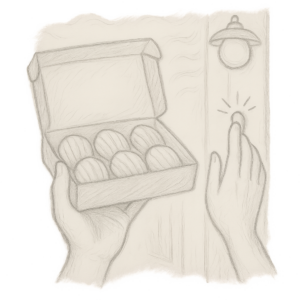
The tray of spiced madeleines nearly tipped out of my hands when I reached for the bell at house number 26. Pieces of Bernice Price began to emerge. First an arm peeled back a pale blue curtain away from the window, then her face rounded the edge, an ear turned, listening. The rest of her, honey-blonde and lean, tilted against the screen door like a stalk of wheat bent by a rough wind. Tired eyes met tired eyes. Everyone in town looked a bit wilted those days, having spent night after night in the dark, sleeping in pools of sweat. She said nothing, and the silence between us hovered above the grass. Dense unmoving evening air.
A light popped on at the edge of the mansion, a dot of yellow against a shadowed stone wall. I stood with my feet squarely on the center of her welcome mat, waiting for her to let me in. After a moment, she stepped out, forcing me to move backward onto the field-stone walkway. The window with its flame-light blocked from my view.
“Nothing to see over there.” She pulled the screen door open for me with one hand while pointing to my tray with the other. “And I didn’t order those. Jesus, you’d think Brent never handled one of my parties before. I always get the same things. Eclairs. Lemon squares. Macarons. Why are you here?”
“Jillian Bloom.” I held my free hand out to her. “Brent’s out of town next weekend, so he asked me to cover. You wanted to discuss what you’d like the bakery to prepare?” I nudged the tray towards her chin, guessing no one could resist the woody pungency of Ceylon cinnamon. “These are just samples. Free of charge. Mind if I put them down in your kitchen?” I bent to look around her, the tray shifting a little too much as I struggled to keep it balanced on one hand. “My wrist aches.”
She stepped aside without a word to lead me down a corridor of empty walls. No photographs or art. Paint as white as doves in every room. The gray kitchen cupboards and countertops, the squeaky-clean grout lines between the stark white squares of her tiled floor reminded me of hospitals and sterile spaces.
“Let’s sit here and get a list of items started. Then we can chat about your pay and how long you’ll need to serve the guests.”
“I’m not staying for your party…”
“Oh – you must. No arguments. I’ll make the tip worth your while.”
The beginning of a frown tugged at the corner of her lips, then disappeared with everything else in front of me. The lights above us and the cool air buzzed for a second before tuckering out. The hum of the fridge became a dying tick tick tick. Her figure moved closer to the window where a slim sliver of dusk light intruded through the blinds.
Her shoulders shook.
“Not another blackout. I can’t take it anymore.” She felt along the countertop for a drawer next to the kitchen sink and pulled out a lighter. The wicks of two candles combusted under her hands, the odor of moss in the forest. They illuminated my notepad with its still-empty order page. It would be a wasted visit. One of the longest days of the year spent fumbling in the dark belly of a darkened house.
“Maybe I should come back another time,” I suggested.
“Maybe I’ll just call the order in.”
“Sure.” I stood up. “I can try to feel my way out.”
Bernice shook her head, her footsteps receding towards the same corridor we’d just come through. She hadn’t taken more than five paces before a thud of colliding shoulders and the crash of glass pierced the stifling air. Crystal popping in the aftermath.
“Who’s there?” I called out as I followed the inhale of her gasps.
“I…I’m…it’s alright. Give me your arm. Try not to step on the pieces.” The voice calling out to me was not hers. He pulled me gently out of the kitchen and led me to the doorway, still holding my upper arm as if I were a disobedient child. Out you get he might as well have said, but I heard kinder words instead.
“You should be able to find the door from here.”
I tried to get a better look at her husband’s face. Lines and shadows in a hot hallway. He tugged at my elbow as I lingered at their threshold, held there by an energy much like that of the sea stretching its fist to grapple sand. Beyond the front door, dead streetlamps stood colorless in the mist. The ring around the moon, witchy and thick. I wanted to apologize, but I didn’t know what for. Wasted time. The rubble of shards on their hallway floor. A fight brewing on the tips of their tongues. Matches of rage, lit.
The screen door slammed shut behind me as they began to shout at each other about carelessness and silly parties and the futility of living in a too-small town. Living like animals in this endless heat. I heard Bernice say it. Out here we’re all on our own. Their tempers barely ebbed the further I edged away from their house. All tempests and cloudbursts.
My bakery truck was parked at the foot of their snake-long driveway, somewhere between the inky pavement and the black horizon. Inside, there would be light above my head and good love songs on the radio. Only a half-minute walk if I didn’t stumble in the dark. The jagged key pressed into my too-warm palm.
I made it halfway before the orb of a flashlight traced my feet in a circular pattern. An unrelenting hunter. And then I heard his voice for the first time. Shuddered, a little.
“Did you light a fuse, then run away?”
I whirled around on the spot, imagining movement behind one of the Chinese dogwood trees that stood like soldiers in neat rows. The orb shut off as unexpectedly as the town’s electric grid, leaving me squinting in the night trying to pin the voice to the shadow.
When I didn’t answer, a different question came. “And did you enjoy it?”
“I…don’t know what you mean. And I can’t see you.” The orange fleck of a cigarette glowed in midair. Moving up and down so gradually in a stranger’s hand.
“Lovers do quarrel I suppose. Heads get hot. Though their shouting was rather quiet for weeks, until…well…here you are. Whomever you are.”
It was bizarre the way this man spoke to me. In a riddle, like Alice in Wonderland’s Cheshire cat with bits and pieces of his body appearing and disappearing in the dark. Mocking me. I stepped backwards towards the truck, tripping over my untied shoelace. His fading voice called out to me, watch yourself, as tiny dots of orange ashes trickled to the ground.
I drove away faster than I’ve ever driven down the long hill of The Green, all the way home along dusky roads. All steel and stars. Summer beacons. The Big Dipper. Cassiopeia. The Belt of Orion. They lit the way through streets as dark as tar until I reached the familiar downtown. All around, clusters of candles burned on sills. Neighbors I’d known for years leaned out of windows in the alleys for fresh air. Paper fans like those I made as a child waved to and fro in their hands. We were desperate for a small breeze, manmade or not, to dry up the beads of sweat on tired brows. Tired like Bernice, that wisp of wheat in the wind. I thought about her for the rest of that night. I would think about her for a long time to come. Leaning against her doorjamb, arms crossed. Her sharp elbows and my unwelcome ghost.
I felt sorry for her before I really knew her. Like a bonfire at the brink of ash. The contrail of a firecracker fading across the night sky. Here, yet also gone. Where I lived in the Alley House, we banded together like a community during the blackouts, handing out the remnants of disintegrating ice cubes from our freezers. While up on The Green, they were scratching each other’s eyes out trying to find the enemy in the nighttime. The devil in disguise.
I’ve always wondered if, at first, she thought it was me.
Chapter 2
Bernice
Before the lights went out, before Jillian Bloom pressed her finger into our doorbell, Donovan had promised to stay in the library. He was always in there in the evenings, decompressing, or ignoring me. All cherry wood and sharp corners. Books and vintage postcards collected through the years. I liked him in there, contained, knowing where his hands were. A door that could close between us. I didn’t need his meddling. He made friends too easily and talked too much with neighbors who had no right to know anything about us. Where we came from, why we lived here, why we don’t have children.
Heat boils the blood. When that scotch tumbler flew out of his grip in the dark, the cosmos must have trembled. He took Jillian’s arm in his hand to lead her carefully over glass crumbs neither of them could see. As if to spare her an invisible pain, leading her blindly towards the doorway, where a cusp of light left in the long western sky was brighter than anything indoors. He acted, for the first time in forever, as if he cared about another person. Maybe I should have been happy about that. A small part of me was. But most of my nerve endings were screaming. He should have stayed out of the way. Let me handle her.
“You’re being unreasonable!” He turned to me after she’d gone. “It was pitch black in here. A stranger in our house could have been hurt.”
“Don’t you dare make me sound crazy! I felt something shift in the air between you. Even without seeing your face. Could hear it in your voice. In the way you moved around her. You gasped for air.”
“I’m not having this conversation with you. The lights went out. I came to see if you needed help. End of story.”
“You’re always looking for someone to save, aren’t you?” I laughed, and the sharpness of his jawline surfaced. Words I should have kept inside my head.
“The heat has made us both edgy tonight. Enough!”
He left me standing on the patio with my untidy thoughts. Then fumbled at the rear of the house with the shed lock, dragging his telescope from one end of the yard to the other. He spent the next hour reading the sky in silence, like every night before. It was the only silver lining of the blackouts. Dazzling stars that made him quiet. Unlike me. Unpolished words and empty eyes.
*
I shoved the screen door open, launching into a wall of wet. No hint of a breeze. Silent windchimes I wanted to sling from their hooks above the front porch. He’d riled me up, wound my nerves so tightly that I couldn’t remember how long we’d stood in the doorway shouting at each other like idiots. I looked up into a night filled with the blinking red dots of airplanes and the fluttery wings of bats. Small Bernice, I thought. A speck of dust and ash amidst the millenniums.
“Trouble in paradise?” Edward Bergman leaned against the trunk of a tree that flanked our adjoining yards. Our next-door neighbor always hung around at night, either him or his wife, Olive. He was a busy-body who smoked outside as much for the news as the nicotine. Stole my attention in the no man’s land of our lawns but didn’t look at me.
“More like hell on earth, actually.”
“You should be more careful, having a worker here in the dark. We don’t know her. People like that see all sorts of opportunities on a street like ours. Just be…aware.” He puffed smoke out of his mouth and tapped the edge of the cigarette’s burning paper.
Opportunities. I imagined the entire gamut of wrongs Jillian could bring into our lives. From petty thievery (did she pick up a ring I’d forgotten on the counter after washing the dishes?) all the way to stabbing us both in the heart with a kitchen knife (also left on the counter). I was all wild imagination and shredded nerves. As combustible as our lightbulbs bursting off unexpectedly like popcorn. All summer long I pined for electricity and winter and a cooler head. A saner head.
“I was expecting the shop owner instead. He’s trustworthy.”
He smiled wickedly, the kind you plaster on when you’re holding good cards in a game. “Opportunity. Can’t really know what someone is capable of, can you?” He pinched his thumb and index finger together above his ear as he sounded out the tunity syllables, as if speaking to a child. Edward the possessive gatekeeper. Godfather figure. I wondered if he was the kind of husband who ordered meals for his wife at restaurants or picked out her wardrobe before a show. Donovan couldn’t control me if he tried.
“You know what I think? We’re all suffocating.” I turned away from him. Said goodnight over my shoulder and tried to put as much distance between us.
“Don’t wash your hands in a dirty river,” he called out to me, taking the last word.
I left him to finish his smoke by the property line just as the streetlamps fizzled back on. Golden strips along the pavement. Windows all ablaze.
Donovan was no longer in the backyard. I lingered in the black square of space behind the library door, caught him bent over a box of postcards at the desk. Copenhagen. Portofino. Biarritz. If he would’ve only stayed there, the entire incident with Jillian that evening might not have happened. He’d have no reason to know her. Without this first encounter, without the heat and the dark and the weight of her arm in his hand, the next time might not have meant a thing. She’d be just another girl from another part of town. But now he would remember her. And I know better than anyone how a memory bores into your bones, once you catch it.
He fed a sheet of paper onto the roller of his candy-apple-red Smith Corona. His prized manual mid-century typewriter. A beauty with no chords attached he’d once punned. That machine was more beloved than me, I supposed. He pressed words into ink through the metal keys and pulled out the page before stuffing it hastily into a book. It was impossible for me to know at that moment what he was doing, though I knew what he was capable of, when my back was turned. I stayed behind the silhouette of the door, pressing my spine further into the wall as if I could disappear through it.
Small Bernice. Waning sliver by sliver like a new moon.
Chapter 3
Donovan
Silence. Imagine holding your breath for an eternity, just to hear the smallest movement. A silver fork laid onto a linen napkin. The drip of the faucet over a filled bathtub. Boar bristles yanked through tangled long hair. Donovan’s house on The Green is like a conch shell perpetually cupped to his ear. He’s always listening for the sound of life within it. He and Bernice say nothing to each other, or they shout. There is no other volume. Just a hollowed-out shell. Maybe it was an eye for an eye, the birth of a bitter wife after the death of a sweet daughter. He shouldn’t have expected everything to return to normal, but he didn’t think he’d be punished for the rest of his days, either.
Jillian Bloom looked at him with the relief of a lost child, unsure in his darkened kitchen. The cotton shirt stuck to his back, and he couldn’t tell what was making him sweat more – the damp heat or the urgency to get them both off the sliver-strewn floor. He was someone’s bridge to safety or a fool whose hand slipped, maybe a little of both. He wanted to sweep the shards into the kitchen garbage, to eradicate the accident, but by then he couldn’t even see the broom in the dark pantry. After they’d exhausted all the yelling energy between them, he and Bernice walked out to the opposite edges of the yard. An unspoken duel. He looked up at a sky of neat stars that were never out of order. Aligning themselves through the centuries to tell the same story. Like Cassiopeia, the queen clinging to a tipping throne. Her daughter forever chained to a rock. On most nights, he could watch the constellations for hours without saying a word. Could watch them rotate inch by inch across the sky in silence. That sultry night, even with the air so heavy it nearly choked him, he would think of a way to type out a smoke signal. An SOS to save his sanity.
*
A creature of habit, his mornings began at The Baker’s Jar promptly at seven, growing old along with every city-bound worker standing in a coffee line. He stared at the back of Brent’s head as the shop owner fumbled with the Pavoni machine to make an Americano. Two heavy floor fans flanked each side of the counter, both set to their highest speed. Twin tornados of cool wind circling around the pants of his suit. And then there was Jillian, switching places, dabbing her black flour-flecked apron with a wet paper towel while balancing stacks of paper cups.
“What else can I get for you?” He was disappointed at the lack of familiarity in her voice. She opened the cash register, rearranged the bills into neater piles.
“I always get a croissant, but now I’m not sure.” He didn’t care that the line of people began to spill onto the street or that he’d miss the 7:45 train if he dawdled any longer. That sort of thing would have normally bothered him. Donovan the automaton.
Jillian reached for a pecan sticky bun inside the display case. She carefully wrapped it in crinkly bakery paper and handed him the bag.
“Just baked this morning.” Their index fingers met halfway above the register.
This wasn’t the same Jillian who stood in his kitchen the other night, overheated and jumpy with worry. He searched for that version of her, the one who took his helping hand. But all he found that morning was a girl comfortable in her familiar habitat. This Jillian – pecan-eyes, her nametag slightly askew, was like his own Cassiopeia come to life. A confident ruler at the head of her kingdom, calling out orders and handing out sweet rewards instead of punishments. He took the coffee from her outstretched hands, pushed a ten-dollar bill into her palm. There were questions he wanted to ask her. Millions of them. Where she lived. Why this job. Her favorite season. He wanted to talk to someone who didn’t hate him. Not yet anyway. But all he could think of to say would have sounded cryptic to a girl who’d only seen a shadow of his face in a stranger’s dim hallway.
“I’ll see you Saturday.” He didn’t expect a response and she didn’t give one. Though her mouth opened just a pinch, not quite enough to form words, as if to catch a memory at the tip of her tongue. Bernice’s upcoming garden party was a Scarlett O’Hara-esque phenomenon. Something they might think about tomorrow, but not today. As he passed in front of the bakery’s picture window, her hand reached up slightly in a farewell wave. A Mona Lisa behind glass, impossible to read or reach.
He trekked from the subway station on Lexington to his office with tacky fingers covered in sugar-syrup glue. The medicinal-smelling soap in the men’s room washed it all away, taking every trace of their morning interaction down the drain and into the abyss of city sewers. In the boardroom, he was distracted by the wall of windows. A flock of birds. A helicopter’s blades twirling like a carnival ride. Someone had filled the fruit bowl in the center of the table. White nectarines and black plums cupped within bamboo. A French press of coffee ruminated on the sideboard, steaming from the pressure within. Colleagues came and went like flies to the fruit. They spoke to him while dabbing at juice drips and the rings of brown puddles beneath their cups. He wasn’t listening. Kept staring at his hands in his lap, his washed hands. He thought of Jillian’s fingers, the cells of her skin reaching his own. And then the soap bubbles that carried everything away in the water’s stream.
“I’m completely fine,” he answered when asked. Big lies. Little lies. White lies.
*
On the late train home, the darkening landscape of blurry lights and steel transitioned into the ash trees of Connecticut. Low roofs and wire fences. Donovan loved to leave the city. He hated to leave the city, too. After crossing state lines, he returned home a ghost. Bernice had left a place setting for one on the kitchen island. A tri-folded napkin, a wine goblet, a dish with medallions of beef. He was ravenous when he poured the merlot, letting its acidic pungency coat his throat with a bitterness that lingered. The meat was cold, its tenderness a long-gone memory in his mouth.
Music from another room stopped playing as she padded into the kitchen like a lioness.
“You haven’t forgotten we’re hosting a party on Saturday, have you?”
“No, I haven’t. Is the guest list going to be a mile long this time?” It was better to be prepared, to know which neighbors he needed to avoid.
“Don’t worry,” she answered with a glacial half-smile. “I’m sure you’ll find a friend.” She cut their conversation short, leaving the air as bitter as a sour grape.
The clank of his wine glass against the granite counter echoed through the kitchen. They were so angry at each other all the time, like birds pecking at another species. But that night there had been no screaming or hurtful words. He knew when to keep his mouth shut – the unwritten rule of unhappy marriages. They were like overfilled balloons with all the words they didn’t let out and didn’t let go of. He retreated to the library with a groan. She sulked off to her bedroom. And neither of them said anything more for the rest of the night.
*
All Bernice ever talked about was perfecting the garden before her summer parties. Her hybrid roses were legendary on The Green. Blooms as big as basketballs. She’d had them planted in neat, alternating rows several years ago. They now spilled beyond the rock wall that was erected to hold them back. Her masterpiece, a young Montmorency cherry tree, had become a towering umbrella for shade-seekers over the years. Donovan was never particularly impressed by beautiful yards made more so by paid landscapers. It was the only botanical specimen she’d gotten her hands dirty for – the kind of labor that required a heavy-duty nail brush and a bar of strong gardener’s soap. And the birds of a feather flocked to her parties each summer. They came early and left late. Days later, neighbors would reminisce about the sangria in the punch bowl, and the music they could dance to, and how no one else’s pretty blossoms grew quite like hers. Those meaningless measuring sticks – he couldn’t care less about them. Though he knew it was all she wanted their guests to speak of. Nothing too private or intrusive or real.
Ask her how high the delphiniums grow. Don’t ask her why she planted that cherry tree.
Chapter 4
Jillian
Olive Bergman wasn’t a stranger. She was as beautiful as she’d always been when we were children, drawing rainbows in chalk on the sidewalks outside Hartford. Childhood shadows, causing no trouble. We’d lost touch after she married a lawyer from New York, so I didn’t expect to see her standing there that morning, in the center of The Baker’s Jar lobby. Flour flecked on her clothes from my hug. Our arms roped around each other. I’d missed her, even though I hadn’t thought about her for several years.
“You’re still ruining my clothes,” she grinned.
“And you’re still gorgeous. What are you doing here?”
“Looking for you. Small town, small world. Edward and I moved here last week. Surprise!” She shrugged her shoulders like a child.
“Can I make you a drink?” I asked her as she sat by the window and hung her designer tote on the wing of a chair. She had that same smooth ponytail as when we were schoolgirls, twisting it around her index finger until it formed a tunnel of curls. Olive turned as I approached with her coffee, fingers shaking slightly as she wrapped them around the tiny cup. Nails painted licorice black. She took a sip and peered through the window at an elderly couple holding hands. The jewel on her left ring-finger wasn’t a diamond but a ruby as bright as a wound. A bleeding, fresh flesh.
“Where do you live now?” I asked.
“We bought a house up the hill, on The Green. Big place with a pool. A bit of paradise just beyond the city. Promise you’ll visit soon.” She put down her mug and cupped my hands in hers, just like she used to do. What a train wreck, I thought, that of all the places in Fairfield County, they chose the one next to the Prices. With their shouts in the nighttime and the slams of screen doors. And a man with a bone to pick at the edge of the lawn. A man I realized had to be her husband, Edward. Smokey Os and orange ash curling up into the dead air. Had they heard the yelling the night I left Bernice and Donovan standing in the foyer, bickering over a busted glass of liquor? A drop in my stomach, like a stone, tethered to my chair. It was no Garden of Eden, I wanted to tell her. Watch for claws and thorns and sides to people that only show up at night. But I didn’t say that. Caught the ruby glimmer as she lifted the cup to her mouth, past a streak of morning sunlight.
“I’d love the grand tour sometime.”
“It’ll seem like a waste to you, but we’re hopeful it won’t always be just the two of us.”
“Of course not.” I played with the hem of my apron, avoiding her wistful eyes.
“What about you? Where is home these days and do you live alone?”
“I’m at the Alley House, across the street,” I pointed, not relishing the possibility of being judged or pitied for it. It was a place to lay my head, with a pocket-sized kitchen and small corners useful for nothing. Chinks of natural light in the mornings and pipes with loud beats. Closets that still smelled of long-ago cedar. On the bay window in the kitchen, I lined up my potted herbs and moved them around like a human sundial. Trying to get them positioned just right. Never being quite sure and starting over again the next morning.
“Must be charming,” she winked at me while blotting her lips on a napkin, leaving a pink orb behind on the paper square. She didn’t force me to answer the second part of her question.
“Listen, I have to get going. Why don’t you come by on Saturday? My neighbor is having a party. You could make new friends.” A question or a statement, or a little of both.
“I’ll think about it,” I answered, even though I’d already circled the date in my calendar.
“Do that.” She finished her coffee and pushed the chair back, linking her bag over her shoulder. Said she had errands to run and hoped to see me that weekend. Her hand rubbed along my arm. Smiling like it was good to see me.
She pushed the glass doors open, letting in the tropical air, an uninvited guest. Blew me a kiss as she crossed the parking lot.
Author Biography: I’m a copy editor whose writing has been longlisted in the Cheshire Novel Prize and Jericho Writers First 500 competition. A Temporary Madness is my love letter to every woman who has left a hospital or doctor’s office with one less heartbeat than she came in with. I live in Connecticut with my husband and son, in a suburb reminiscent of my story’s setting.