
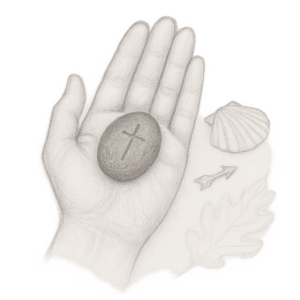
Midway through our meal, Kate made an announcement. She was going to walk 500 miles of the Camino de Santiago, an ancient pilgrimage in Northern Spain. She was leaving the following summer and would take five weeks for the trek.
Winner of The Letter Review Prize for Books
The Search for the Phoenix Woman
Chapter 1: Dark
I come from a long line of women who don’t sleep. We scan the perimeter of our shadowed rooms with flint-sharpened ears, waiting with unfurled talons, lionesses prepared to protect. When we do sleep, we dream—brash, lucid, radiant dreams that scream “listen!” in prophetic tones. My mom received a warning the night before we moved into my childhood home, a place I will call, for the extent of this story, the House on Central Street.
She dreamt that she was standing alone on the screened-in front porch as a storm approached. A gust of wind rushed through the house, forcing open all the windows and doors. It roared across the walls, down the basement steps, and all through the bedrooms, like a scream on the run.
“A baby was crying,” she told us, “A baby was somewhere in the house, but I couldn’t figure out where it was coming from. I should have seen it as a sign.”
By the time I was 11, I was in the habit of lying awake at night and staring up at the glow-in-the-dark stars adhered to my ceiling that loosely spelled out my name. The two N’s in GINNY never quite formed properly; the stars marking the diagonals were too far apart. It looked more like GIHHY. I’d made a few attempts to reach upward on my tippy toes, but I always came up short.
That night in early July, I’d given up on my stars. We were moving soon. Moving. I wrote the word on the edge of looseleaf at school, like other pre-teens would idolize a crush. Moving. Disappearing. Running away.
As I typically did on nights without sleep, I played a game to pass the time. Closing my eyes, I categorized every slam, honk, and holler in the neighborhood as either a safe sound or a threatening sound. Cat jumping from the kitchen counter: safe sound. Mom’s feet shuffling through the hallway across the torn carpeting: safe sound. A creak from the outer edge of the top step: unsure. My mind jumped to the kitchen knife sandwiched between my mattress and box spring. I’d snuck it out of the drawer next to the sink and wondered if anyone had noticed.
Just after 2 a.m., the shrill honk of a car alarm caught my attention. I knew by then that there was nothing too out of the ordinary about a car alarm in our town. Neighbors set them off every day for fun by smashing their thumbs into the remote. This night was different. The tone of the alarm shifted, and its pitch plummeted like a distorted videotape about to burn up in the VCR. There was a blast, a boom loud enough to instinctively send my body levitating up and out of bed. Adrenaline blurs memories and makes us feel like superheroes capable of flying.
My ears rang as I sprinted into the hallway. When my parents and sister joined me there, we shuffled into our familiar emergency positions. My mom, sister, and I locked ourselves in the bathroom, and my dad went downstairs to investigate the situation. It didn’t take long for him to come back upstairs to fetch us.
“The cops are on their way,” I imagine he must have said, “But there’s no one out there. Just the car on fire.” His face was tired.
We carried our bodies down the steps and into the dining room without exchanging another word. Moving boxes cluttered the floor, and cats that slept on their taped-up lids, undisturbed by the noises outside. Beyond the windows, the front lawn, and inches out of reach of the towering ash tree, I watched 10-foot flames engulf the charred skeleton of a car.
I covered my mouth as the wretched smell of melting plastic hit my nose, but otherwise, we didn’t move. We stood there like shell-shocked soldiers, watching the car burn as if it were on TV in someone else’s reality.
I suppose this was nothing compared to what we’d already been through—the break-ins, the robberies, and every night my sister almost didn’t come home. It was nothing compared to the knife fight outside my birthday party or prank phone calls in the middle of the day that threatened to kidnap my sister (or worse).
It had been almost 10 years since my parents bought the house and four years since we put it on the market. It turned out that no one wanted to buy a house in a neighborhood where people frequently set things on fire.
The flames around the car lapped higher.
“Is it going to catch on the branches?” I asked my dad.
“No, it’s farther away than it looks.”
Celtic folklore considers the ash tree sacred, but I didn’t need to know that at the time. I knew in my stomach that it looked over us. While the tree would survive the fire that night, it wouldn’t survive an infestation of invasive insects that would leave the block treeless and barren in the summer light for the next several decades.
Later that night, the cops told us that the car had been set on fire on purpose, likely because it had been stolen and someone needed to get rid of the evidence. We assumed the act was related to the group of men terrorizing my sister—a threat, perhaps. But this time, we were wrong. The car explosion was random. It was just yet another thing to add to the list, yet another near-miss of violence caused by poor geographical luck.
I spent the rest of the night trapped between exhaustion and vigilance. We had to get out, I told myself over and over. I studied the trails of wrinkles on my parents’ faces as they gave the cops things to write down in their pads of paper. My parents were far too young to look that old. My sister sat on the couch, looking shaken and equally concerned that she’d somehow get blamed for this.
We had to stay alive for the final days in that house, I told myself. If we could just get out, then everything would be okay.
***
Four years after we escaped, I rested in the same bed in a new home, looking up at a blank ceiling with no stars. We did move. We did get out. We escaped to a rural town where bears and ticks replaced the threat of other humans. The White Pages no longer listed our names. The only sounds outside my window that night were the croaks of a local bullfrog and the occasional shuffle of branches dancing in the fall wind.
The next morning, I had my first panic attack while sitting in 9th grade English class. I remember laughing when it started. I loved that class; I felt accepted there. Five of us had broken into a discussion group about King Arthur, swiveling our desks into a circle to face each other. I was giggling about something particularly clever that a friend had just added to the conversation when a hollow ache crawled up into the center of my throat and spread through the tip of my head. Fuzzy gray curtains framed my vision, and by the time I managed to stand up, the curtains had closed entirely. A therapist would later tell me that some people have panic attacks when they feel their best. Letting your guard down can cause your brain to overcompensate.
Doctors poked, prodded, and asked me to “try harder” at a series of breathing tests in the back room of a hospital later that week. When they decided it was just an old-fashioned panic attack and not asthma, they sent me home with no instructions.
***
Eighteen years after we escaped, my husband Ben and I were renting the first-floor apartment in a quiet suburban town. Ben was one of the rare people who knew all my stories from the House on Central Street. He understood why I still stashed a knife between my mattress and the box spring and why we needed to announce “the door is locked” to each other before going to bed.
He and I marked the anniversary of escaping the House on Central Street every July 15th, sometimes with a toast or a long walk. My life revolved around how much time had passed since my family spent our first night under the towering trees and beside the lake with the bullfrog. That year, I spent the first part of the day celebrating by visiting my friend Kate.
Kate and I sat on the outside stone patio of a coffee shop with two lattes and a set of neatly constructed veggie wraps. The sunlight trickled through the branches, spilling out onto our table in a prism of shattered color.
Midway through our meal, Kate made an announcement. She was going to walk 500 miles of the Camino de Santiago, an ancient pilgrimage in Northern Spain. She was leaving the following summer and would take five weeks for the trek.
I took a deep breath in. I was thrilled for her. There’s no better news than someone telling me that they’re walking the Camino. I’d studied the pilgrimage in college and walked it just after graduating, my 22-year-old mind throwing itself into the trail without the fear of what I’d find there. Not only had the trip shifted my identity into someone capable of large physical feats—never my strong suit beforehand—but it taught me that the trail had the power to plunge your mind into the forgotten neural connections that existed before you covered them up with the protective shell of adulthood.
I glared down at my half-eaten wrap as an intuitive twist in my stomach encouraged me to speak up. I didn’t want to stay behind. Sure, I had a great husband, a quiet home, and a stable job. And yet, please, please take me with you, rushed through my mind.
The panic attacks that started back on the day in high school English class still followed me, like wolves watching for a moment of vulnerability. They waited in the dark house at night, in shadowy parking lots, and on the other side of loud noises. The wolves looked like the shadowy faces I imagined waiting outside my windows and in the backyard. They sounded like my mom crying downstairs when she thought we couldn’t hear her. Their fur, when they were very close, felt like the rough carpet I’d dig my fingers into when I was hiding from my sister. I knew that we had moved, that we had escaped, but my body didn’t believe it.
On days when the wolves circled me, the Camino made me feel like there was something else—that elusive Something Else that we all hope will rescue us from the desperation of empty hours.
She set down her cup and looked me in the eye. “Come with me.”
This was no small suggestion, and Kate knew that. I’d have to quit my job to go with her.
“Yes,” I told her. “Let’s go. Let’s do it.”
We pulled out our phones and marked July 7th on the calendar as our starting date at the base of the Pyrenees in France. July 7, 2017: or 7/7/17. The countdown began. There were fewer than 12 months to go.
Ben was relieved when I told him. “I always knew you would go back eventually,” he assured me while moving closer for a hug. “I think it has to be now or you’re never going to go.”
The impact of the decision hit me like a wave that looked smaller from the shore. My new form of vigilance as an adult was budgeting. I ran to my Excel sheet, fiddled with the numbers, and obsessed over what would need to happen for me to walk away from my job. And while I’d been slowly growing a small online writing business for years, it was far from enough to hold up my end of the financial bargain. Twelve months. I could figure this out in 12 months.
Money became a game I could win, an obsession. The numbers needed to add up. One freelance assignment paid for three days on the Camino. A large editing job paid for the flight. A small bonus from my full-time job bought my boots, my backpack, and my headlamp. The numbers released me.
***
Just under 19 years after we escaped—and 36 hours before the Camino—I stopped sleeping entirely. Maybe it’s because I knew what was coming. Both terror and deep, grounded peace danced back and forth in my mind. I was going back to the horizons that galloped away into the distance, the glowing yellow arrows, and the long dinner tables of pilgrims with sunburned faces and big smiles. Back to my assumed-lost identity of “pilgrim.”
On the other hand, I couldn’t explain for the life of me why I agreed to do this. Why would I put myself through the blisters, muscle pain, exhaustion, and snoring?
When my panic came to a head, a familiar wave of nausea welled up in my throat. I launched myself out of bed and hurried to the bathroom, careful not to wake up Ben. Deep breaths, I told myself, deep breathing will make this all go away.
I placed my fingers just below the outside of my chin bone to feel my pulse. Blood slammed against my skin at the same pace as the drumming in my ears. Sweat crested down my forehead, the back of my neck, and my lower back. It was hot outside, but not this hot outside. My breath quickened.
Maybe you’re really sick this time, a voice told me. It’s probably your heart. All that training. It was too much this time. Maybe it’s a stroke. Does your face feel numb? It did, but not from a stroke, I told myself. Why did panic attacks always have to be about dying? It was all or nothing. This is going to pass; this always passes. I waited. And breathed. And waited.
Ben found me in my usual spot on the bathroom floor, 20 minutes later, balanced in a meditative state with one elbow propped on the edge of the closed toilet. My mom always taught me that it’s easier not to look at the open bowl if you’re trying not to throw up.
He perched on the side of the tub and ran his hand gently over my back until I declared with certainty that it was yet another panic attack and not food poisoning, a heart attack, or a stroke. I sent him back to bed with a squeeze of his hand and walked to the living room to settle into the stillness of 3 a.m. at the dining room table.
I preferred the wooden chairs over the couch. I knew I wouldn’t fall asleep there accidentally and miss my chance to lie back down next to Ben. We only had two nights left together before six weeks apart.
The traffic light outside the window switched from green to red and back to green again without a car in between. I made a game out of counting the seconds between the lights and listening to the noises of the neighborhood. The air around me ticked, cracked, and settled in the night. I closed my eyes, unfurled my talons, and waited for the shrill beep of a car alarm that never came.
Chapter 2: Stone
The final hours of the night’s darkness evaporated into a breath of space. After a blink, a blip in the film of consciousness, the sun infiltrated the room by sneaking around the edges of the blackout curtains. Ben had already gotten out of bed and sat sipping coffee in the living room, energized by the promise of the weekend. After rolling over onto my stomach, I smushed my face into the crevice of the pillows. It was my last day at home before the Camino.
There’s a considerable difference between planning a 500-mile hike and getting out the door to do it. I sank deeper into the memory foam as a nauseating wave of exhaustion from the night before slurped through my stomach. Panic attacks often come with a hangover of shoulder tension and rotten adrenaline.
Enough of this, I decided, get it together. My body swung out of bed like a marionette doll, and I headed to the dresser to pick out clothing for my last long walk. Like a marathon runner, I was “tapering” my training. I had about six miles ahead of me to at least keep my muscles warm. There was no going back now. The 10 or 15-mile walks were behind me, so there would be no way of telling if the training had done its job until I tried to cross the Pyrenees on our first day of walking.
After a luxuriously long cup of coffee next to Ben’s side, I walked out the back door and into the crisp early July air. I’d studied every curb and corner of our neighborhood during a year of Camino training. There were no more surprises sneaking around the next street sign; nothing changed, and everyone liked it that way. The wind smelled of brunch—coffee, eggs, and a tang of syrup. When I turned onto the main avenue, a line of early brunch-goers sat at outdoor tables ready to drop $60 on something that would cost $5 to make at home. They were already set up with their New York Times and hardback novels as the waiters topped up their coffee mugs. My relentless judgment of their lifestyle was getting old. When did I decide that I knew the perfect way to live? And anyway, I envied their stability.
Just sit down at one of these tables and you’ll never have to leave, a voice in my mind whispered. I slipped my headphones into my ears to muffle the doubts and looked down at my phone. Just a couple of days earlier, Spotify’s uncanny algorithm sent me a modern choral composer named Ola Gjeilo. It felt like a hand had reached down from the Great Unknown to score the soundtrack of my upcoming trip.
After pressing play, Gjeilo’s choir sang the words of a Yeats poem. The bitterness about suburban living and dread of the journey ahead lifted from my chest.
I will arise and go now,
And go to Innisfree,
And a small cabin build there, of clay and wattles made;
Nine bean-rows will I have there, a hive for the honey-bee,
And live alone in the bee-loud glade.
The chords built and fell again like the progressive slopes that reveal a mountain’s hidden summit.
And I shall have some peace there, for peace comes dropping slow,
Dropping from the veils of the morning to where the cricket sings;
There midnight’s all a glimmer, and noon a purple glow,
And evening full of the linnet’s wings.
I closed my eyes as my hair filled with summer-scented air, a hint of bark and leaves reviving my yearning to return to something I’d lost. In the final measures, the vocalists and string instruments resolve together, calmed by the notion that they knew they were going to arrive all along.
I will arise and go now, for always night and day
I hear lake water lapping with low sounds by the shore;
While I stand on the roadway, or on the pavements grey,
I hear it in the deep heart’s core.
I opened my eyes and allowed my mind to loosen its grip. Dr. Daniel J. Levitin, a musician, neuroscientist, and the author of I Heard There Was a Secret Chor, taught me about this psychological Narnia. The Default Mode Network (DMN)—a term coined by another neurologist named Marcus Raichle—is the state of mind that welcomes daydreaming. Both walking and music can bring you to this place, a world far from multitasking and catastrophizing. Some psychological theories even suggest that the DMN acts as a place to rebuild autobiographical memories.
In this elusive mode, my mind often snuck back to the House on Central Street, drifting down the Parkway, through the trash-ridden streets, and right up to the sentinel ash tree that stood guard in front of our front door. The neural connections in my mind that tried to construct the story of those years now looked more like a torn-up manuscript with its pages tossed around the room. I never had the full book, at least not enough of it to tell the story. Sometimes, I had illustrations, but not the page numbers. Other times, the chapter names, but not the dialogue.
The Default Mode Network picked up the pages from the floor and delicately slipped them back into its original binding. That day, my brain revived illustrations of houses. Unlike the gentle old Victorians on my walk, the Central Street homes were cursed with rotting porch steps, paint that peeled in uneven ribbons, and overgrown lawns that hid rusted children’s bikes, car batteries, and beer bottles.
As a kid, I loved our house despite its decay. The sloping roof mimicked a worried, furrowed brow, the upstairs windows two concerned eyes, and the front porch door a solemn mouth ready to ask you what was wrong. Around the back, you’d find a rectangular driveway with two spots, a dilapidated wooden garage, a small metal swing set, and two symmetrical gardens with a line of grass down the middle. A handful of 100-year-old trees towered over the backyard, including one that made helicopter seeds that you’d open and stick to your nose in the summer.
Up until 1994, the backyard was our sacred hiding place from a town that loved to appear in the daily news cycle. One of the first carjackings in the country happened several miles away, and my parents had to explain to us why we should always lock the doors when sitting in traffic. Rival gangs fought on nearby streets in neighborhoods, “The cops don’t even drive through at night,” as my dad put it. The playground across the street not only hid broken glass in its sandboxes, but hypodermic needles—a word I couldn’t quite pronounce yet.
At yet, in that small backyard, my dad played whiffle ball with me and my sister. The off-kilter metal slide acted as first base, the birdbath as second, and my mom’s rust-colored Datsun as third. I’d swing on our old rusty jungle gym for hours in the summer, reaching my toes up toward the branches of the tree to try to catch leaves between them. My sister and I awarded each other Olympic medals for the fake events. Absorbed in the splendor of the summer Olympics, we’d push the metal swings to their maximum trajectory, launch our bodies into the air, land—mostly—on two feet before throwing both our arms up in the air to the imaginary sound of applause.
They say that childhood memories are fictitious before a certain age, constructed from family stories and hints from photographs. Perhaps that’s why everything felt safe in the beginning.
***
My mind returned to a body knocked off-kilter. Prickling heat climbed up my cheeks, and my heart sped ahead of me. I often wondered if my body was fighting against the attempt to reconstruct these memories.
I then realized that I’d made it to the center of downtown on autopilot. The mom-and-pop store owners were setting up for the day, carrying sandwich boards with the daily specials handwritten in chalk. A high-end antique store offered the best window shopping. It showed off prized statues and furniture that had spent their lives sitting in old-money, untouched living rooms, likely ignored for decades. I longed to free the beauties and place them on the small mantle of our rented apartment to praise them daily. This wasn’t, however, the type of place that had price tags.
The sunlight cut through the antique store’s window and caught the gleam of my favorite statue. A bronze woman with an aged green patina stood in a long, flowing, and unrestrictive dress with her head thrown back and her arms raised. Perched on the edge of her outstretched hands, sat a phoenix preparing to take flight. The bird’s elongated tail feathered out below its body and rested upon the woman’s shoulder. Even locked in time, the woman seemed to lift off from the pedestal, ready to join the phoenix in its resurrective flight.
I’d passed the woman with the phoenix countless times on my Camino training walks. Her energy was a foreign concept to me. Back straight, arms lifted, and untethered enthusiasm for this bird didn’t mirror any recent muscle memory of mine. I subtly smiled at her, whispered a hello, and set off in the direction of home.
Ben was standing at the stove when I staggered into the kitchen through the back door.
“I made breakfast!” he exclaimed with his arms in the air.
“You made breakfast!” I answered, throwing my arms up to mirror him while moving in for a kiss. “You’re already proving my coworkers wrong.”
More than one person had jokingly-not-so-jokingly asked if Ben was going to be able to feed himself while I was gone.
“I don’t want to go,” I sighed, squeezing him around his shoulders.
“You don’t mean that,” he said into my ear.
“My knee hurts too much. I’m staying home. We can watch Netflix and never leave the house.”
Ben squeezed me one more time and turned back to the eggs sizzling around their edges. “Have some breakfast; decide later.”
Ben and I’d met at a bar on the Lower East Side eight years earlier, just months after I got back from my first Camino. I was at a birthday party where no one could have cared less about what I had to say. My ex-boyfriend sat at one end of the table, talking to a hipster too jaded to reciprocate his flirtations. The birthday girl was on the other end, fixated on a scruffy actor type talking about his recent Shakespearean role. I stared into my foaming craft beer that I couldn’t afford and pretended that I didn’t need conversation to keep me company.
And then Ben walked in. He sat next to me and announced that he would buy my next beer. He asked me about travel, and we marveled at what it’s like to see far-away places up close. We got married four years later under a willow tree, two blocks from the sea.
The day charged ahead too quickly for my nerves. Every hour slipped by like blurred faces passing on a carousel. The sky turned a burning orange when night threatened the end of the day, so Ben and I wandered into the park. The cops were just starting to circle the pathways to close for the night. I had to hurry. I was searching for my stone for the Cruz de Ferro.
There is an iron cross that marks the highest point of the Camino Frances. You’ll hear a different story about the meaning of the cross depending on who you talk to. Historically, the Cruz de Ferro is just one of many humilladeros—or shrines—along the way to honor the god Mercury.
“How do you know when you find the right one?” Ben asked.
“I won’t,” I answered, “I just need to pick one.”
Pilgrims carry a stone from their hometown and leave it at the base of the cross. The ritual is an opportunity to leave your burdens behind and—quite literally—lighten your load. The stones are a reminder of everyone’s troubles and what we’re willing to do to let them go.
I planned to carry my stone alongside my grandma’s funeral card, who had passed away weeks before our wedding. My grandma would have loved the fact that I was walking the Camino again. She was one of those good Catholics—loving, generous, curious, and brilliant. The priest at her funeral gave a homily on how she inspired him to study religious philosophers. She never knew that I’d walked away from the religion altogether.
Ben and I ambled through the park until we reached our favorite spot beneath a set of oaks with gnarled arms that beckoned young climbers. I reached out to touch the arm of the oak etched with hearts, dates, and names of local teenagers. Poor tree. The dimming light of the evening cut through its leaves and redirected my eye to the ground. I leaned over and picked up a small black stone that looked ready for a journey.
The weight of the adventure ahead washed over me. Once I began the Camino, I wouldn’t be able to hide from my memories about the House on Central Street any longer. Ben wouldn’t be close to coach me through panic attacks, and I wouldn’t be able to escape the quiet rooms of my mind designed for putting my old story back together.
As I stared at the stone, I imagined all the characters from that part of my life— my parents, my sister, and a small 11-year-old me standing on the trail, waiting solemnly. Who else—and what else—was waiting for me there? I closed my fist around the stone and told Ben it was time to go home.
After over a decade as a writer and long-distance hiker, Ginny Bartolone has developed an active online community of pilgrims and mentees. Her blog, Maybe There Will Be Cupcakes, covers extensive Camino advice as well as how to maintain a healthy life as an artist. Her writing has been featured in Salon, The Matador Network, and Club + Resort Chef, as well as literary journals such as After Dinner Conversation, Flumes, The Closed Eye Open, and The Bluebird Word. She has also been featured on two Camino-themed podcasts, The Camino Podcast with David Whitson and My Camino with Dan Mullins. In 2024, her Camino-related social media account, @DearPilgrim, won an international competition for a trip to Helsinki to learn about why Finland is the happiest place on earth.