

How has your writing process changed over time?
In July of 2024, I had a mountain biking accident that left me with a mild traumatic brain injury (mTBI), which sounds a lot cooler than it actually was. (Note to everyone: the front and back brake levers on a bicycle are reversed in the US and the UK…) Although to me, there was nothing mild about it. My memory, concentration, energy, and ability to call upon and use language were all profoundly affected, among other things. My ability to simply think about something and write it down on the page evaporated overnight. I would have a concept in mind, but when I sat down to write, the thoughts dissolved like mist. Even my usually extremely busy and noisy brain went alarmingly silent. It was a frightening and overwhelming experience. Very gradually, with the help of many different therapies and some awesome therapists, I have learned to think and move through the world differently.
Somewhat paradoxically, writing has been essential to my recovery. In my case, the adage “the only way out is through” is absolutely true. I used to write in great bursts when inspiration struck, which was amazing when there was inspiration and endlessly frustrating when there wasn’t. This pattern will probably feel familiar to many other creatives. My new cognitive energy levels no longer supported such an onslaught. Since direct thought-to-page writing is difficult, I am learning to write in a more associative manner, sneaking up on my subject indirectly. Maybe I want to write about homesickness, or what it’s like to live in a different country. Those topics are too big to hold on to, but maybe I can explain the differences in the grass’s particular shades of green between the UK and Arkansas.
I am learning to pace myself, working in short, brain-friendly sessions in the morning or evening instead of these idealized all-day marathons, which rarely ever happen anyway. I can’t force thoughts to come, but I can create patterns in my day that invite ideas to arrive, whatever form they take.
I may not be able to write an entire garden right now, but I can write the sunlight on a beetle’s wing. Repeated actions, no matter how small, add up in incredible ways. This associative, gentle way of writing has absolutely revolutionized my creative life, opening new frontiers in my work. Although many TBI effects still frustrate me, and I hope I’ll continue healing, I’m profoundly grateful for this healthier creative process.
What motivates you to write?
For a long time, I heard the writing advice, “only write when you have something to say,” and felt vaguely guilty because that has rarely been the case for me. My mind is absolutely whirring with activity: thoughts, questions, observations, associations, and rabbit trails are all vying for attention. How can I discern what, if anything, I have to say when it’s so noisy in my mind?
When I write, discovery is my primary purpose. It is an organic process, somewhat like foraging and somewhat like quietly waiting in a forest to see which animal might approach. Following my curiosity is one of my favorite parts of writing. Once I have a seed, I grow it through investigation and clarification until I understand what I am writing about. Next comes synthesizing and remixing, sometimes to create order out of chaos, other times to make jazz of the subject: to make it strange, to test it, and prod it. I meander through these stages freely, gathering insights like little shells, leaves, and stones. Finally, I hope to arrive at a new understanding I can articulate in a way that feels honest and exciting.
Who do you see as your literary forebears?
The works of Madeleine L’Engle found me early and never let go. First, it was the A Wrinkle in Time books. They felt different from anything I had encountered, yet oddly familiar. The books put words to concepts I felt but couldn’t express. I felt seen. I loved that Meg Murray wasn’t perfect, and that her family was mostly made up of brilliant outsiders.
What electrifies me about L’Engle is how she bridges scientific concepts and spiritual themes. Facts and truth, reason and wonder, are woven together with beautiful language and lived experiences. It’s surprisingly rare to find writers who lean equally into both realms.
A few years ago, I read her book The Rock That Is Higher, which she wrote after a traumatic accident. It is a memoir of a brilliant artist wrestling with her faith, her creativity, and her sense of purpose in a world full of both beauty and hardship. I also love that she, like her protagonist Meg Murray, doesn’t smooth off her rough edges. She was unapologetically herself—a delightful oddball despite considerable pushback. That gives me a lot of hope.
What do you see as the function of your art?
I see my poetry as a way to find, experience, and express wonder.
I work as an X-ray interpreter in the aerospace industry, a job that seems just about as different from writing as possible. However, it has taught me to observe closely, to find patterns, and to discern the true signal through the noise. I look inside components to see how they are put together and diagnose problems. Poetry gives me the opportunity to use those skills in a different way: to seek truth amid the interference patterns we live with daily; to look beyond the surface of a person, idea, or situation; and to document my discoveries.
Beyond my process, I want to point people toward the light. For me, art is a roaring protest against darkness, even when it isn’t explicitly political. These are uncertain times, with many deep shadows. Artists swallow chasms of grief, fear, displacement, pain, and hate and transform them into beauty and light. I hope my craft can continue that work.
I try to give language to the things we don’t yet have language for. Poetry becomes a bridge connecting the physical world with the internal landscape: reason and mystery, myths and modernity, science and faith. I love finding the strange, contradictory tangles in my mind and trying either to reconcile them or to find peace living in the complexity. Ultimately, writing helps me cultivate a more loving, embodied life. I’ve noticed that the closer I observe something, the more I love and understand it. Even things that scare me—maybe especially those.
What are some profound or meaningful experiences as a writer?
Two experiences come to mind: one is a transformative alchemy of friendship, inspiration, and education, and the other is an invigorating mental rediscovery.
The first happened in the summer of 2022 while I was at my creative writing program in Oxford, a special summer session that brought students from all over the world. Their fellowship and friendship remade me. Until then, writing had been almost entirely solitary. It was refreshing and freeing to be with such kindred spirits. We shared many of the same struggles: imposter syndrome, moments of intimidation, and the challenge of making writing happen at all. We delighted in each other’s successes and unique talents, and I developed profound friendships with many of them. I am grateful and amazed that writing brought us together.
The second was the revelation that, for the first time since my TBI, I was able to enter a flow state while writing. It is an incredible feeling. Sometimes the words come, and it feels as though I am simply a riverbed carrying a river rather than making ideas myself. For a time, I thought I might never experience that again, so discovering that I can, even if only a couple of times recently, achieve that kind of creative energy and focus is a gift I will never take for granted.
What do you find most inspiring?
I find inspiration all around me. I tend to follow wherever my current enthusiasm leads, and I have a great many of them!
I love color with my whole heart. It is endlessly fascinating to me, from the way our eyes perceive it to the physics of the spectrum and the science and long history of pigments. Music inspires me as well. It can express so much without a single word, transcending cultures and time.
The natural world delights and entices me. Whether it’s a mockingbird’s song, moss, a meteor shower, or mitochondria, there is always something new to learn.
I love great stories, regardless of genre. I’m fascinated by other people’s passions and love hearing them talk about what excites them. My family and friends inspire me simply by being themselves. Ultimately, discovery and imagination are my twin creative flames.
If you would like to, please share a photo of your bookshelf and let us know why it is meaningful to you.
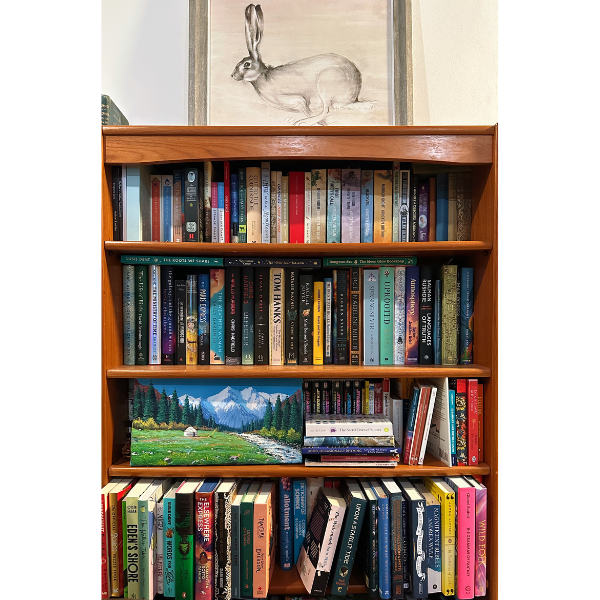
This is the bookshelf in my living room. It is a bit of a mess!
Both my husband and I are readers, and we tend to have books in various collections around the house, mine always seeming to multiply on our limited shelving space… Sadly, we don’t have endless space for the great library of my dreams (complete with a rolling ladder), so I rotate books out to make room for new ones—with limited success, as you can see from the double shelving.
I do reserve space for a special collection of nice editions of books and authors I particularly love on the large shelf. There are some old favorites, some new friends, and a fair amount of aspirational reading as well.
Lately I’ve been especially enjoying books in translation, folk and fairytale retellings, seafaring adventures, and—somewhat oddly—stories set on trains. Really, anything that takes me on a surprising adventure!
Ashley Williamson is the winner of the 2026 Letter Review Poetry Prize for her long poem, “The Word.” An Oxford-educated poet and radiographic interpreter in the aerospace industry, she explores the intersections of science, myth, memory, and the natural world. Her pamphlet, Particles and Waves, was longlisted for the 2023 Mslexia Pamphlet Prize, and her poetry has appeared or is forthcoming in Mantis (Stanford University), Juste Milieu, The Write Launch, and La Piccioletta Barca. Originally from the American South, she now lives, writes, and adventures in the English Lake District. Website: www.ashleywilliamson.co.uk