
Before my brother and I began school, my father’s Greek uncle gave my father the 30 acres of land to build a new split-entry three bedroom home in the late 1970s.
Winner of The Letter Review Prize for Nonfiction
Beside Island Lake
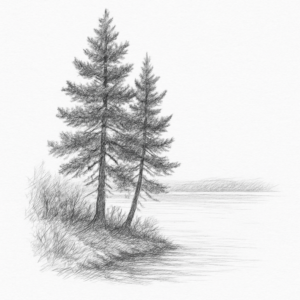
I grew up on Island Lake, a 500 acre lake along the border between Pine and Carlton counties in east-central Minnesota. In the 1950s, one of my father’s mother’s sisters and her Greek immigrant husband from Minneapolis, MN bought 30 acres of tax-forfeited land at the end of a dead-end gravel road from a farmer near Island Lake to build a summer cabin. Eventually, they expanded the cabin into a year-round residence. Before my brother and I began school, my father’s Greek uncle gave my father the 30 acres of land to build a new split-entry three bedroom home in the late 1970s. When my father was a teenager, he planted Norway Pine trees on the adjacent 30 acres of abandoned pasture to create a lakeside pine plantation.
Our lakeshore property was the envy of the area. We owned the most lakeshore of any resident on Island Lake. My father thought that many people in our area thought my father was a millionaire because he owned so much precious land. People in the nearby town of Moose Lake, MN would sometimes ask us if we were ever going to sell any of our land. My father allowed some of our neighbors to cross-country ski our trail through the pine plantation in the winter. During the fall, my father harvested trees in the pine plantation to be sent to paper mills for pulp wood. My father thought his pine plantation would yield fairly high profits, but the pine plantation ended up being more of a hobby and habitat for wildlife and watershed preservation. In addition to the lake, my father dug a swamp area into a pond that froze over in the winter to form an ice-skating rink. Over the years, we saw wildlife such as black bears, deer, snapping turtles, foxes, woodchucks, raccoons, skunks, porcupines, loons, herons, and numerous insects saunter through our property.
When we built our house, the township was planning on putting in a sewer system around Island Lake. Those plans, however, never came to fruition. So we relied on two holding tanks that sometimes overflowed into our basement. My father refused to install a septic system, even though the sewer pumping company always told us that a septic system would pay off in the long run. So we rationed water so the tanks did not need to be emptied frequently.
Since the television cable lines did not reach our area, we only got the local television affiliates from Duluth, MN for television until we installed a rooftop antenna to bring in the Twin Cities television affiliates, too. Since the antenna was pointed into thick forest, we often had quite snowy reception. From an early age, I was obsessed with watching the local and national news. I would rotate watching each network and network affiliate each week. When I was a teenager, I constructed a news set in my bedroom to deliver the news based on WCCO-TV and KARE-TV.
One of our neighbors along our road had two young daughters that my brother and I passed the time with during summers off from school. My father did not get along very well with the parents of the neighbor daughters in part because they were zealous evangelical Christians, and my father was an agnostic Lutheran who really wanted to be a Unitarian.
On the other side of our pine plantation, the author Carol Bly kept a home. My father got to know Carol enough to interview her about her writing career. Carol encouraged my father’s writing projects, but she never had enough time to be a real mentor for him with her writing career taking off plus her teaching responsibilities at Hamline University. Carol was the only person on the lake who had a sail boat. Carol’s ex-husband, the poet Robert Bly, split his time between the Twin Cities and Moose Lake. Every Valentine’s Day, Robert gave a free poetry reading at one of the local Lutheran churches. During the reading, he usually told a fairy tale while donning various masks. He would invite the audience over to his house after the readings.
When I was in third grade, my mother was diagnosed with colon cancer when she was 36 years-old. At the time, it was about the youngest colon cancer case my mother’s doctor had ever seen. The surgeon my mother saw in Duluth, MN told my mother that she would have to have a colostomy for the rest of her life. Eventually, one of our relatives in the Twin Cities suggested that my mother get a second opinion from a surgeon they once had had at Abbot-Northwestern in Minneapolis. The Twin Cities surgeon performed an eight hour surgery, and my mother was able to forget about having a colostomy for life.
My brother and I had plenty of room around our house to try sporting activities. Growing up, we tried badminton, soccer, baseball, basketball, football, swimming, cross-country skiing, and ice-skating. At school, however, my brother and I both excelled at academics. My brother was a math whiz, who took college math at The University of Minnesota, Duluth beginning in ninth grade, and I had significant and sometimes leading roles in many theatrical productions. During 10th grade, I landed the role as Bo Decker in William Inge’s Bus Stop. The director did not really have me in mind for the lead role until the auditions. He was a bit hesitant to cast me, as he wondered if I would be comfortable kissing the female lead Cherie. Since I had reddish-blond hair, the director changed the line “He kind of looks like Burt Lancaster” to “He kind of looks like Danny Kaye”.
Both my brother and I had our earliest inklings that we might be gay beside Island Lake. I was attracted to actor Don Diamont when I would watch The Young and the Restless during the summers. I liked looking at my father’s Penthouse magazines because they included nude men. I was attracted to body building magazines, not so much for emulating the body builders, but for the male specimens on display. Some of my brother’s peers wrote in his yearbook that “I hope you don’t turn queer.” At one family reunion, we met cousins who had moved to San Francisco. One of those cousins was a gay hairdresser. In another branch of the family, we had a gay cousin who lived in Seattle and who had majored in English and Women’s Studies at Washington State University. In our region, my elderly paternal cousin Helen had raised two children before divorcing her husband to live with a woman the family referred to as “Sis”. I dated females for many years. It was only much later after we had left Island Lake behind that my brother and I came out to our parents as gay.
My father worked as a forester for the Department of Natural Resources office in Moose Lake. He did not get along with his supervisor. My father’s toxic workplace environment was a constant source of stress for him. My father thought about moving many times because of his job, but he just was not able to give up his prized land. My father battled his work stress by working on writing projects, learning the Swedish language, gambling, drinking alcohol (usually moderately), occasionally smoking cigars, fishing, hunting, reading, and watching movies.
In order to generate extra income to pay for our property taxes, my father was always interested in side-hustles. His main side-hustle was our pine plantation, but he also received his real estate license. He tried real estate, but he soon found out he was too reserved for showing real estate. He also helped fight forest fires at Yellowstone National Park and in southern California for extra income. My mother took various jobs like as a child-care worker at a daycare center, a waitress, and as a hostess at Grand Casino Hinckley. Since my brother and I never owned cars as teenagers, we often biked seven miles into Moose Lake to work at our summer jobs.
My father thought it was important to seize the day and the time you have in the present. He had been diagnosed with quite severe hypertension in his late 20s. His father died when he was 63. My father did not want to wait until he retired to travel. So we took almost yearly summer vacation road trips mainly to the West Coast, Intermountain West, and Canada. In 1990, my father spent time in Europe traveling to Sweden, Norway, Germany, and the Netherlands, which was partially funded with state grant money he won to study the timber industry in Sweden.
In 1985, when I was 10 years old, I spent a summer month in Finland visiting my mother’s relatives since she was a Finnish immigrant. One of the highlights of my trip to Finland was meeting my Great Uncle Stig Hasto, who had been the manager of a textile mill. He had worked to modernize the Finnish textile industry from a tariff and protectionist based industry towards a more free trade approach. During our meeting, we ate at an outdoor cafe in the planned Helsinki suburb of Tapiola. My mother’s father Per Olof never wanted to know my mother after he divorced my grandmother. His brother Stig kept the ties to my mother’s father’s side of the family. My mother’s half-brother, who has an MBA from Stanford, was CEO of the Finnish fashion company Marimekko during the late 1980s to the mid 1990s. One of his legacies at Marimekko was opening their first retail location in New York City.
By the early 1990s, my father could not withstand his work environment anymore, so he took a new job as forestry district manager in Detroit Lakes, MN after I graduated from high school. Since he did not want to sell all of his 30 acres, he bought the cheapest house he could find in Detroit Lakes, MN with the hopes of moving back to Island Lake after he retired. By 2000, he got kidney failure and died of a stroke at age 54, making him unable to realize his dream of a new Swedish-style home with a Japanese garden beside Island Lake.
My father’s funeral was held at the same Lutheran church in Minneapolis where he had been confirmed and married. My best childhood friend’s father officiated the funeral, as he was a Lutheran pastor. He was open-minded enough to do the service, even though my father rarely attended church. My father’s former supervisor from Moose Lake, who he never got along with, attended the funeral and commended my father for the work he had done as a forester. The funeral meal was catered by a Greek restaurant in honor of my father’s beloved Greek uncle and the legacy of the land that he let him have. Whenever my father was in Minneapolis, he usually liked to eat at a Greek restaurant.
In 2005, my mother decided to sell all 30 acres because she did not feel like building a new home by herself. My father’s will stated that the proceeds from the real estate transaction had to be split evenly between my mother, my brother, and I. For ten years, I was able to live off the real estate proceeds and augment my savings with adjunct college teaching. Today, my childhood home is worth about $500,000, and the people who bought our land have built a $1,000,000 home where my father was going to build his retirement home. If my father had enjoyed his work, then we could have preserved the pine plantation and lakeshore property and kept it in the family. Growing up, my brother and I often took our lakeshore property for granted. We both loved the times we took trips down to the Twin Cities to visit relatives. We did not realize it then, but most of our relatives in the Twin Cities would have much rather lived on 30 acres of land by a lake rather than a city lot or subdivision. In reality, maybe those relatives did not possess the same romantic imagination that my father had and would be unable to live without urban amenities and better jobs.
Author Biography: I was born in Duluth, Minnesota, USA. I grew up between Duluth and the Twin Cities. My formal education occurred at The University of Minnesota, Morris and Purdue University. My work has ranged from scientific research to adjunct college teaching. My travels have taken me to 24 states, five Canadian provinces, and the Nordic region.