
Poetry creates shared language and uses that shared language to communicate ideas and bait them with beauty. I’m still learning both how to communicate beautifully and how to chase beauty until it communicates something.
Would you please tell us a little about your writing process?
My writing process might sound a little strange: the majority of my poems are written while walking out of doors. I say each line into the speech-to-text feature on my phone and, once the poem is done, text it to myself. From there, I copy the raw (often typo-rich) text into a Google Doc and start rewriting and rearranging.
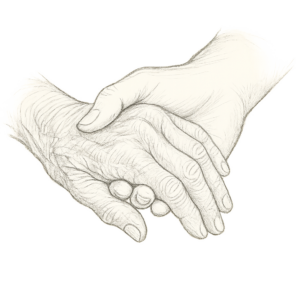
My poem ‘October Hands’ in this round of the Letter Review was actually written in the car (not the most advisable method, but I survived). A glimpse of something about the structure of my hand on the steering wheel coupled with the way my skin looked in the dry air sparked the poem.
Revision is crucial: you have to push the poem till it moves. I tend to overwrite, so I am almost always condensing, identifying where I have unnecessary redundancies or where I am just iterating through different metaphors all trying to say the same thing. I used to think poetry was all intuition: it is mostly perspiration. I have at least one moment with every poem where I despair of ever making it better.
It is also crucial to have people whose input you trust to show your poems to. My dad is my best editor.
What motivated / motivates you to write?
I must write. Seneca once wrote, “Destiny leads the willing, but drags the reluctant.” I feel both a little led and a little dragged. There is another quote from runner and missionary Eric Liddell where he says, “I believe God made me for a purpose. He also made me fast, and when I run, I feel His pleasure.” I am first and foremost a Christian and a servant of God: my motivation to write comes because I believe God has created me to write. I am responsible to work at this gift because God has first worked it in me. And when I write, I feel His pleasure.
Do you enjoy writing?
I’ll go ahead and answer “yes” to this question, but I also resonate with the saying (which has many forms and no original source that I can find) “I hate writing but I love having written.” The moments within writing that I love are when I am suspended again in the central image or “feeling” of the poem, experiencing it over and over again until the crashing of the waves can form itself into words. I love the way that writing can sweep me away entirely.
But it is also hard work. Focus is the one thing needful and often the hardest to come by. Write when the inspiration strikes you: it creates its own focus.
What is the best piece of advice you have received? Or, what is the best piece of advice you would offer an aspiring writer?
Listen to David Perell’s interview with Dana Gioia, “The Deepest Conversation You’ll Ever Hear About Writing.”
My dad sent me that interview and I listened to it over the course of several drives to and from work: it was life-changing. Dana Gioia knew he wanted to be a poet but he went to school for business. He worked more hours than I do, but he spent all his spare ones writing and rewriting poetry.
I can’t give any advice much better than Mr. Gioia’s, so I’ll leave it at that.
What do you believe is the function of your art?
I’m still finding that out. Part of my current quest in my writing and in my life is to find out what God wants to use poetry for in the world and in the Church. Currently, I write my sermon notes every week in the form of a rough-drafted poem. I then revise these as fast as I can to send them out to the congregation around Thursday or Friday as part of a mid-week, sermon-discussion email chain that we have.
I think this might be the most “functional” part of my art: art must be part of a community, it needs an audience. Poetry creates shared language and uses that shared language to communicate ideas and bait them with beauty. I’m still learning both how to communicate beautifully and how to chase beauty until it communicates something.
Who would you say are your literary forebears? Who have you learned the most from?
Oddly enough, I think the poetry of J.R.R Tolkien, scattered through the Lord of the Rings, is what made me fall in love with poetry. In particular, the song that Sam sings at the beginning of The Return of the King when he and Frodo are in the orc tower in Mordor. “Beyond all towers strong and high / Beyond all mountains steep…”
Dylan Thomas’ poem “Do not go gentle into that good night” is another of my favorites, along with “Stopping by the Woods on a Snowy Evening” by Robert Frost. I must confess I have not read as much poetry as I ought to have, so I am much more influenced by individual poems than poets.
Recently, I have begun to listen to a lot of W.B. Yeats, T.S. Eliot, and Seamus Heaney. I find myself internalizing patterns and having my own poetic patterns refreshed and reconfigured by interacting with the work of these authors. You have to be careful not to copy motifs carte blanche: Eliot’s electric combinations of dramatic but mundane imagery, Seamus Heaney’s alliterative litanies of adjectives, Yeats references to roses…
Which books is it most important for an aspiring writer to read?
This is going to be an unusual answer: Saving the Appearances and Poetic Diction by Owen Barfield. Barfield was onto something about the nature of words and meaning that I think is largely missed today. These books can give you a good ground in why words matter and why poetry matters (the famous essay by Dana Gioia by that name is also a good read).
Owen Barfield, however, is a philosopher and his work is not an easy read. It takes concentration and resigning yourself to just moving on and hoping you understand later. One usually does, but it’s a process.
Where are the best places to live / visit as a writer?
Exactly where you are. This sounds like a cop out (or an excuse from someone who doesn’t travel much), but you will never be able to visit well if you do not live well. You need to understand that your language, your power and relevance as a writer, comes from where you live and what you do every day. There are wonderful poems from individuals who visit “interesting” places, but these poems really use the new experience of travel to intensify the pre-existing local lens.
In Your Paris by Ted Hughes, Ted is visiting Paris with his wife, Sylvia Plath. Paris becomes the focal point for the exploration of his and Sylvia’s different prior experiences with Paris and varying personal backgrounds. The Parisian present tells us about Hughes’ past (his war experiences and how that has shaped him).
Poetry is a method of immersion: learn to be totally immersed in where you live and what you and those around you do. Then, apply the same immersion to the places where you travel. A writer’s metabolism is made of action and reflection: we must do things and have experiences, then reflect on them in an echoing corridor of art and creative imagining, reimagining, and memory until they reach their zenith of radiance and meaning.
TLDR; go places, but if you do not immerse yourself in the place you already are, it won’t help.
If you were to begin writing today for the first time, would you do anything differently? Which would be your first steps?
In Fragment 89 of Heraclitus, he says “The waking have one common world, but the sleeping turn aside each into a world of his own.”
Writing is not about expressing my world, it is about waking to the common world, learning to open the eyes that I have been given and see what I have not dreamed. A poem is not an individual expressing his own truth: it is an individual apprehending the truth.
I was slow to learn this lesson. I always felt a tension between “preachiness” and self-pitying confession in my poems. My first step with this would be to write poems for others. I would ask myself whether what I am saying is worth hearing.
Caleb Hill works in cyber security by day and writes poetry around the clock. He lives in central Pennsylvania, where he sleeps on the floor in an upstairs corner of his parent’s house. He chops vegetables to give his mind a break from writing. When that doesn’t work, he buys fruit. He has been writing poetry since his father taught him the haiku on his eighth birthday. He has featured in one or two of his father’s published poems, but has not yet published one himself. He found out about the Letter Review Prize from a Reddit post about poetry prizes.