

Just writing, and discovering how your own voice sounds on a page, is so important, and anything can be tidied with various rounds of editing later.
Would you please tell us a little about your writing process?
When it comes to the writing I do as a journalist, my process is always very structured, as there isn’t much time to waste with frequent deadlines. However, when it came to my book, the process was somewhat erratic. As I was continuing to live the story while I was trying to write it, a lot of the process involved me just venting onto the page without much direction except for my life’s own chronology. I’d just let the emotions and thoughts flood out of me and make sense of what I was trying to say later.
As I was also working in different jobs for most of the time I was writing the book, it also meant I was squeezing in time to work on it where I could, which wasn’t easy. I’d write the odd passage on a train journey, on the weekends, and even on holiday. But, no matter where I was, whether I was wiping the sand off my keys while sat on a sunny beach or sticking my headphones in my ears to drown out the sound of the train, I would get caught up in my work and lose track of my surroundings.
I’m sure for the next book I write, I’ll have a much more structured process, but for this book, I think the raw authenticity of the way it was pieced together makes it even more personal.
What motivated / motivates you to write?
While there are many things that have motivated me to write over the years, I think it all started when I was six years old. I often found it hard to sleep, either finding it difficult to switch my busy brain off or being frightened by nightmares thanks to my vivid imagination. Trying to delay my bed time, I started to insist on telling my Dad bedtime stories when he tucked me into bed – even though often either he or my Mum had already told my brother and I a story. I’d make these stories up on the spot, trying to keep him with me for as long as I could get away with. No matter how silly these stories were, my Dad listened and laughed, and encouraged me to continue letting my imagination run wild. As I got older, and these stories began to take more shape, forming a series with reoccurring characters, he would frequently tell me to start writing them down. His patience, the fact he always gave me the space to be a story-teller, and his continued belief in me made him my most powerful motivator.
What are the most important steps an amateur writer can take?
As an amateur writer myself, and someone who’s still trying to figure out and master their own craft, I would say it’s important to not be afraid of writing something you don’t think is your best work. Just writing, and discovering how your own voice sounds on a page, is so important, and anything can be tidied with various rounds of editing later. I also think seizing any opportunity to ask other writers questions about their experience and work can be so helpful. The journalist in me has always asked questions, and it’s meant I’ve had the chance to speak to successful authors who’ve shared so much wisdom with me. Doing courses and competitions are great too, as it encourages you to not only keep on writing new things, but also to share your work with others.
What do you believe is the function of your art?
I think there are two key functions to the writing I do. The first involves shedding light on important topics through sharing people’s stories – a lot of what I do as a journalist. I’ve spoken to a huge range of people and helping them get their stories heard enabled me to shed light on key issues, informing readers as well as making those who have experienced similar circumstances, feel less alone. It’s also allowed me to connect with some deeply inspiring people. Using my writing to give people a voice was eventually something I turned to myself. In the midst of my sickness, when I felt unheard and isolated, I gave myself a space to share my own story, and that narrative helped me feel empowered.
The second thing is that writing has also enabled me to connect with my loved ones more. While I was going through my long Covid recovery, I often wasn’t able to articulate how I felt to those around me. I couldn’t find the words and didn’t have the strength to utter them out loud. Writing my story and then sharing it with the people I love was a hugely cathartic experience and helped me feel closer to them again.
What have been your most meaningful or profound experiences as a writer?
I think my most profound experience as a writer was the process of writing this book. It was like one massive journaling session, just with some interviews and research thrown in. So many times when I sat down to work on it, the words poured out of me and I barely noticed the tick of multiple hours go by. Even when I felt so overcome with illness during my long Covid journey, getting this story down on the page felt like it shifted so much of my mental fog, and lifted a huge weight off my chest. It gave me a space to say all the things I couldn’t talk about out loud, and by the end, it felt like I’d emotionally decluttered.
Are there any downsides to being a writer?
I think writers can often be their own worst critics, which can make it hard to get into a ‘flow state’ with writing and not get caught up on all the negatives you think are riddled into your own work. I’ve certainly spent a lot of time in the past, chewing my lip in self-doubt while bashing away at my laptop keys, determinedly editing the same paragraph over and over again, thinking it’s not good enough, rather than just carrying on and coming back to it with a fresh pair of eyes. As writing is so subjective, it means you’re often left with all of your own insecurities and biases each time you read your own work, and it can make it hard to continue writing when that inner critic won’t keep quiet. I think this is why it helps to come back to your work with a fresh pair of eyes, when hopefully you can be more balanced in your own self-judgement, and also sharing your writing with others can be just as valuable.
Where are the best places to live / visit as a writer?
I don’t think there’s any one best place to live as a writer, but I do think experiencing different cultures and lifestyles can bring different energies and tones to someone’s writing. I spent three months teaching English in Italy, and living the Mediterranean lifestyle for a prolonged period of time forced me to slow down and start noticing, and appreciating, the simple pleasures in life. As a result, when writing about this time in my book, I noticed when editing it later how much slower the pace was, how descriptive it was, and how many more details I brought in. It brought a different vibrancy to my work. On the other hand, I found the hustle and bustle of London brought a faster pace to my writing and gave me the drive to continue reaching out to experts to interview as part of the research of the book. Both aspects were crucial, and helped bring balance to my work.
Would you mind sharing a photograph of a part of your bookshelf (or your library) that is meaningful to you? What makes it meaningful to you?
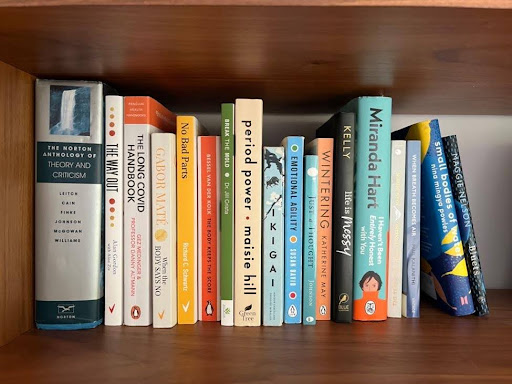
This part of my book shelf is particularly meaningful to me because these are all the books I read while writing this book. Each one of these books gave me new insight, inspired me, and helped me learn how to regain lost fragments of my mental and physical health. The massive range in genre of all these books I think goes to show just quite how far-reaching this learning curve has been, as well as how much this book ended up covering. By the end, it wasn’t just a memoir about long Covid, it was a story about a girl in her early twenties learning how to survive each new battle that came her way, while finding ways of enjoying life despite navigating chronic illness. It also became a story about a lost girl slowly coming find a sense of certainty in her own body and identity.
Author Biography: I’ve been working as a journalist for past few years, covering a wide range of topics for both U.S. and U.K. news outlets, as well as a local London radio station. Currently, I work as a U.S. News Reporter for Newsweek, focusing mostly on American health policy, health insurance, and health more broadly – looking at new scientific studies, issues relating to different chronic conditions, drinking water contamination and many other matters.
Outside of journalism, I’ve loved story-telling ever since I was a child. From writing short stories and making comic strips, my childhood was filled with creativity and the written word; both of which continue to reside in many aspects of my young adult life. Writing has been a massive part of my life for as long as I can remember, and I hope to continue writing books in the years to come.